 ultimate-guide
7 Benefits of Switching to a Tankless Water Heater
Last Updated: October 28, 2026
Quick Summary
A tankless water heater is a gas or electric unit that heats water only when a fixture calls for it, instead of keeping a large tank hot around the clock. Homeowners switch for endless hot water, lower standby energy loss, freed floor space and a longer-lived appliance.
- Size the unit by adding up the fixtures you run at the same time and checking the GPM rating.
- Compare the uniform energy factor ratings from EnergyGuide labels to estimate your own savings.
- Ask for a line-item quote covering gas line, venting, electrical and water treatment work.
- Flush the unit regularly, since skipping descaling is the most common reason for early failure.
- Test water hardness before choosing a unit, especially for homes served by private wells.
Table of Contents
- Why Homeowners Are Switching to Tankless Water Heaters
- Endless Hot Water and On-Demand Heating
- Energy Efficiency, Standby Loss and Utility Savings
- Space-Saving Design and Compact Installation
- Tankless Water Heater Installation Cost and Upfront Tradeoffs
- Tankless Water Heater Life Expectancy Compared to Tank Models
- Tankless Water Heater Maintenance Tips That Protect Your Investment
- Booking a Tankless Water Heater Assessment for Your Home
- Frequently Asked Questions
Why Homeowners Are Switching to Tankless Water Heaters
England's Plumbing & Heating has served Chester County since 1989. A tankless water heater is a gas or electric unit that heats water only when a fixture calls for it, rather than keeping a large insulated tank hot around the clock.
Homeowners tend to make the switch for a few recurring reasons: they want to stop running out of hot water, they want to reduce standby energy loss, they want to free up floor space, and they want a longer-lived appliance.
Keep in mind that the benefits depend on your home's water use, fuel type and plumbing layout.
Endless Hot Water and On-Demand Heating
The core advantage of a tankless system is that it does not run out of hot water in the way a tank does. A conventional tank holds a fixed volume and runs dry once that volume is drawn down.
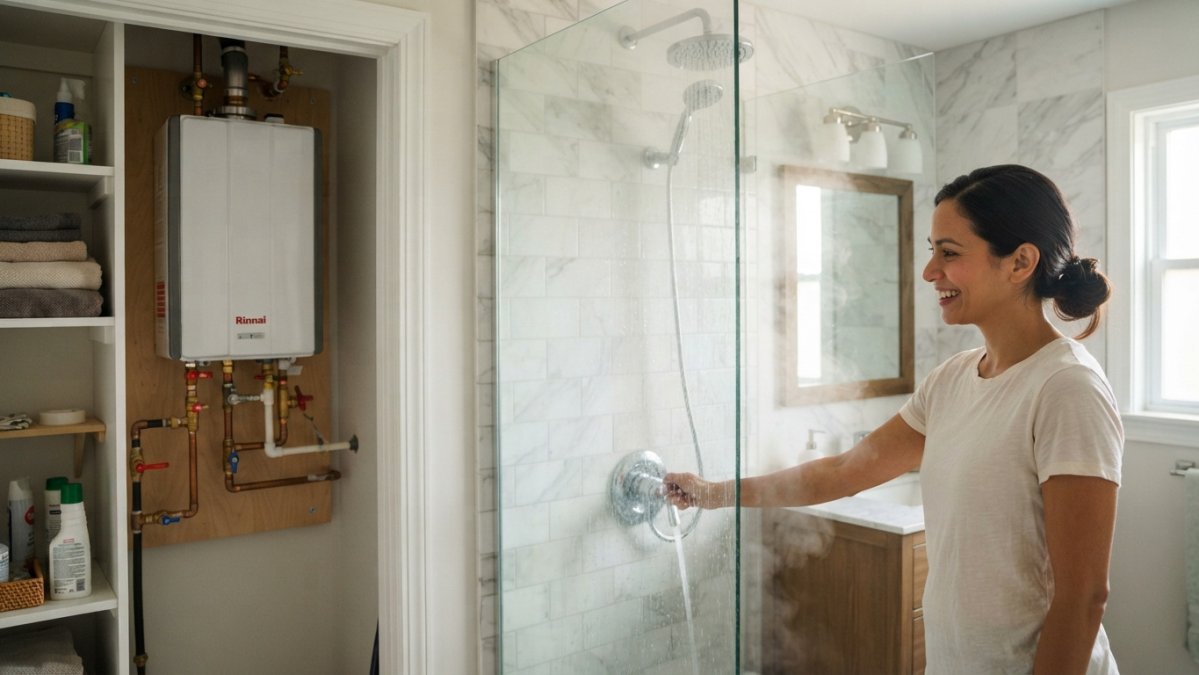
Flow rate is where sizing matters most. A unit that is too small for simultaneous use, such as a shower running while the dishwasher fills, will deliver lukewarm water when demand peaks.
Homes that rely on heat from the same unit for showers, laundry and kitchen tasks often notice the difference most.
Energy Efficiency, Standby Loss and Utility Savings
Much of a conventional tank's energy use goes to keeping stored water hot around the clock, a loss known as standby energy loss. A tankless unit eliminates most of that because it only fires when a hot-water fixture is opened. The efficiency gain is real, but its size depends heavily on household usage, and the way to estimate it is more concrete than a generic percentage.
Where the savings actually come from
Three mechanisms drive the difference:
- Standby loss elimination. A tank maintains its set temperature 24 hours a day, even when no one is home. The U.S. Department of Energy's Energy Saver guidance notes that standby losses can account for a meaningful share of a storage water heater's annual energy use, and that share grows in tanks with older or thinner insulation.
- Higher combustion efficiency on gas models. Condensing tankless units recover heat from exhaust gases that a standard tank vents away. Non-condensing tankless units are closer to tank efficiency, so the model class matters as much as the category.
- No standing pilot. Gas tankless models use electronic ignition rather than a continuously burning pilot light, removing a small but constant draw.
A simple way to estimate your own savings
Rather than trusting a salesperson's percentage, work from your own bill:
- Find the annual cost of water heating on your utility statements. If gas and electric are bundled, the DOE's Energy Saver appliance calculator can help you split out the water-heating share.
- Identify your current unit's energy factor or uniform energy factor rating from its yellow EnergyGuide label.
- Compare that rating against the uniform energy factor of the tankless model you're considering. The difference in rating, applied to your annual water-heating cost, gives a rough savings range.
- Adjust downward for any hot-water use that is intermittent or low-volume, since a tankless unit gains less in households that draw hot water in short bursts.
A common pattern is that households with steady, heavy demand, several showers, laundry and dishwashing on the same schedule, see the largest savings, while a couple who runs hot water only occasionally may see a modest difference that takes many years to recover the higher upfront cost.
The tradeoff competitors skip
Energy savings are only half of the total cost of ownership equation. A tankless unit typically costs more upfront, and the installation may require gas line upgrades, venting changes or electrical work.
Electric resistance tankless models deserve a separate caution: they avoid venting, but they can require significant electrical service capacity, and in many homes the added panel or circuit work offsets a large share of the energy savings. Confirm voltage and amperage requirements before purchase.
The article breaks down where tankless savings come from and how to estimate them from your own bill.
| Savings source | How it works | Key point |
|---|---|---|
| Standby loss elimination | Tank keeps water hot 24 hours a day | Tankless fires only when a fixture opens |
| Condensing gas efficiency | Recovers heat from exhaust gases | Non-condensing models are closer to tank efficiency |
| No standing pilot | Uses electronic ignition | Removes a small, constant energy draw |
| Estimate step: rating difference | Compare EnergyGuide ratings | Apply the difference to your annual water-heating cost |
| Estimate step: usage pattern | Adjust for intermittent use | Light, short-burst use gains less |
Space-Saving Design and Compact Installation
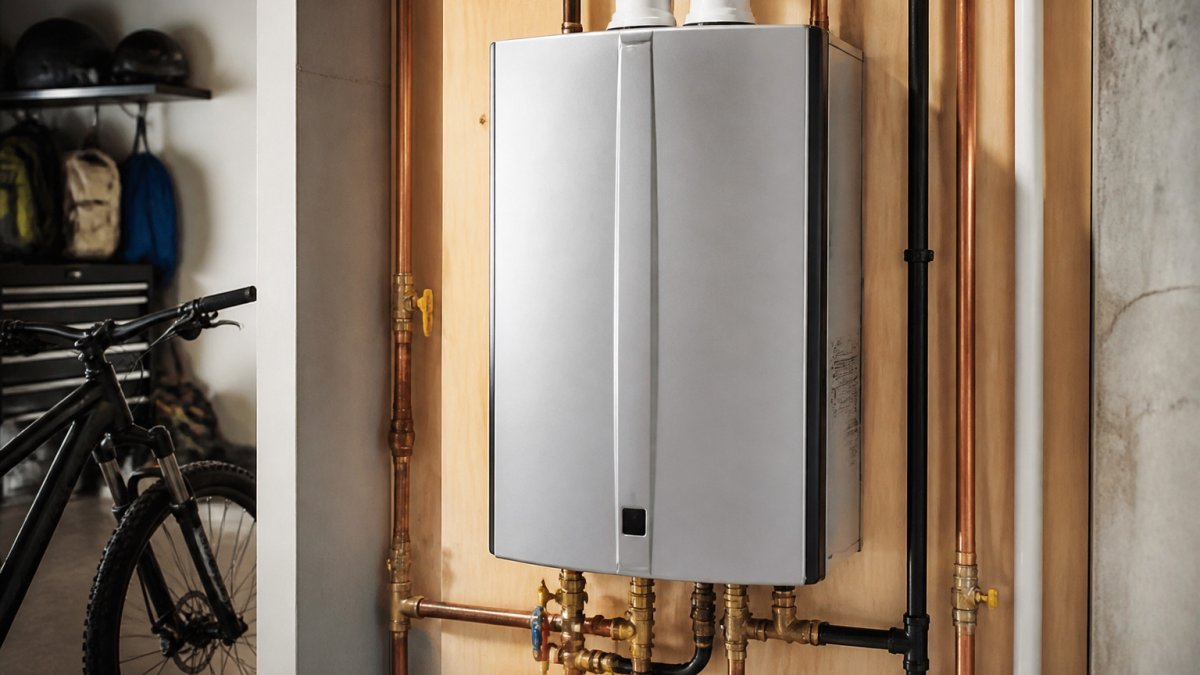
Tankless units mount on a wall, typically in a utility room, garage or basement, and free the floor space that a bulky tank occupies. For smaller homes and condominiums, this can be a meaningful gain, and it is one of the few benefits that is immediately visible.
Installation is not always simpler, though. Venting requirements for gas units, the need for a gas line of adequate size, and clearance rules around the unit all shape where it can go. Retrofitting a tankless unit into a space designed for a tank often means reworking vent runs or upgrading gas piping. Those costs belong in your planning from the start.
Tankless Water Heater Installation Cost and Upfront Tradeoffs
Installation cost is the factor that deters many homeowners, and it is where tankless systems differ most from a like-for-like tank replacement. The unit itself is usually priced above a comparable tank, and the total installed cost often includes gas line sizing, venting upgrades, electrical work for electric models, and a water quality assessment. What most guides skip is why those line items appear, and how much they can add.
The retrofitting challenges most guides ignore
A tankless unit is not a drop-in replacement for a tank. In an existing home, the installation usually involves several of the following:
- Gas line upsizing. Tankless gas units fire at a much higher BTU input than a storage tank, often requiring a larger-diameter gas line from the meter. If the existing line is undersized, the unit may short-cycle or fail to reach its rated capacity. A licensed plumber or gas fitter should perform a load calculation before purchase.
- Venting changes. Condensing tankless units need Category IV venting, often PVC or CPVC, with specific slope and termination requirements. Non-condensing units need stainless steel venting. Either way, the vent run may need to be rerouted through a wall or roof, which is a labor-intensive change in finished spaces.
- Electrical work for electric models. Electric tankless units draw high amperage and may require a dedicated circuit, a larger panel, or a service upgrade. In older homes, the panel upgrade alone can be a significant line item.
- Water quality assessment. Hard water accelerates scale buildup in the heat exchanger, so a water test and, if needed, a softener or descaling plan belong in the budget from the start.
- Relocation of the unit. Moving the unit from a basement or utility closet to a wall near the point of use can shorten wait times for hot water but adds plumbing and venting labor.
Federal tax credits and incentives
The federal government offers an energy efficiency tax credit for qualifying tankless water heaters through the Energy Efficient Home Improvement Credit. The credit is a percentage of the installed cost, subject to an annual cap, and eligibility depends on the model meeting specific efficiency standards. Because program rules and caps change, confirm current eligibility with the U.S. Department of Energy's Energy Saver guidance on water heaters and with a tax professional before assuming any credit applies. State and utility rebates may also be available; check your state energy office and your utility's rebate page.
Putting the upfront cost in context
A tankless installation quote should be compared against two numbers, not one: the installed cost of a like-for-like tank replacement, and the estimated annual energy savings from the previous section. The difference between those figures is the premium you are paying for endless hot water, space savings and a longer service life. For some households that premium is justified on comfort and space alone; for others, the payback period is the deciding factor.
To ask about pricing for your home, book a tankless water heater assessment with England's Plumbing & Heating.
Tankless Water Heater Life Expectancy Compared to Tank Models
Tankless units generally have a longer expected service life than conventional tanks, which is one reason the benefit is often cited.
Water hardness is a major factor. In hard-water areas, mineral scale builds up inside the heat exchanger and reduces efficiency and longevity unless the unit is descaled or a water treatment system is installed.
Tank models also have a finite life, and an aging tank can fail suddenly and flood a space. A tankless unit that is correctly sized and maintained tends to degrade more gradually, which can make planning easier.
Tankless Water Heater Maintenance Tips That Protect Your Investment
Maintenance is the variable most within your control. Flush the unit periodically to remove mineral buildup, and follow the manufacturer's descaling schedule, which is shorter in hard-water areas. Check the air intake and exhaust vents for blockages on gas models, and have the gas connections and burner inspected during routine service.
Watch out: skipping descaling is the most common reason a tankless unit loses efficiency or fails early, and the damage is often not visible until hot water output drops.
Keep a simple log of service dates and any error codes the unit displays. That record helps a technician diagnose problems faster and supports warranty claims.
Booking a Tankless Water Heater Assessment for Your Home
Choosing between a tank and a tankless system comes down to your household's hot water demand, fuel type, water quality, available space and budget. The benefits covered above are real, but whether they add up for your home depends on those specifics.
You can book online to ask about your options and request a quote.
Frequently Asked Questions
Is a tankless water heater more money?
For current pricing, contact England's Plumbing & Heating for a quote.
Can you run two showers with a tankless water heater?
Yes, but the result depends on the unit's flow rate in gallons per minute (GPM) and its temperature rise. Many tankless models are sized to supply two fixtures at once, but if both showers run hot at the same time, the water may not reach the desired temperature on a smaller unit. Check the GPM rating at the temperature you need, and consider a larger model or a whole-home system if simultaneous use is common in your household.
Can I replace my 40-gallon water heater with a tankless model?
In many homes you can, but the swap is rarely a simple one-for-one change. A tankless unit typically requires a gas line sized for its BTU input, or an electrical service capable of handling its load, along with proper venting or a condensate drain. Water hardness also matters, because mineral buildup can shorten the life of the heat exchanger without a water conditioning plan. A site assessment will confirm whether your existing plumbing and utilities can support the upgrade.
What is the life expectancy of a tankless water heater?
Tankless water heaters often last longer than conventional tank models, commonly around 20 years or more with regular maintenance. The lifespan depends heavily on water quality, descaling frequency and installation quality. Hard water shortens service life by building scale on the heat exchanger, so annual flushing and descaling are especially important in areas with mineral-rich supply water. England's Plumbing & Heating can assess your water conditions and recommend a maintenance schedule.