 listicle
Signs Water Heater Needs Replacement: 8 Warning Signs
Table of Contents
- How to Tell If Your Water Heater Is Failing: 8 Warning Signs
- 1. Age: When Your Tank Nears the End of Its Service Life
- 2. Puddling, Drips, and Water Heater Leaking From Bottom
- 3. Rusty or Discolored Hot Water
- 4. Knocking, Popping, or Rumbling Noises
- 5. Inconsistent Water Temperature and Lukewarm Showers
- 6. Less Hot Water and Slower Recovery
- 7. Smelly or Metallic-Tasting Water
- 8. Visible Corrosion, Rust Streaks, or a Failing Pressure Relief Valve
- The Average Lifespan of a Water Heater (and What Shortens It)
- Tank vs Tankless: Warning Signs That Are Unique to Each Type
- What It Costs to Replace a Water Heater (and How to Decide Repair vs Replacement)
- A Simple Water Heater Maintenance Schedule That Extends Lifespan
- Your 10-Minute DIY Water Heater Inspection Checklist
- When to Call a Professional for Water Heater Replacement
- Frequently Asked Questions
Last Updated: September 14, 2026
How to Tell If Your Water Heater Is Failing: 8 Warning Signs
Knowing the signs water heater needs replacement can mean the difference between a planned upgrade and a flooded basement. Most tanks rarely fail without warning. This guide from England's Plumbing & Heating breaks down the eight signals that matter, plus how to decide between repair and replacement.
A water heater is a storage tank that heats water through gas burners or electric elements and holds it at temperature until you open a tap. When that tank corrodes from the inside, no repair fully reverses the damage.
1. Age: When Your Tank Nears the End of Its Service Life
The first sign isn't how the unit looks, it's the date on the manufacturer's label.
The serial number's first digits encode the manufacture date. A unit past its expected service life is running on borrowed time, even if it seems fine today.
2. Puddling, Drips, and Water Heater Leaking From Bottom
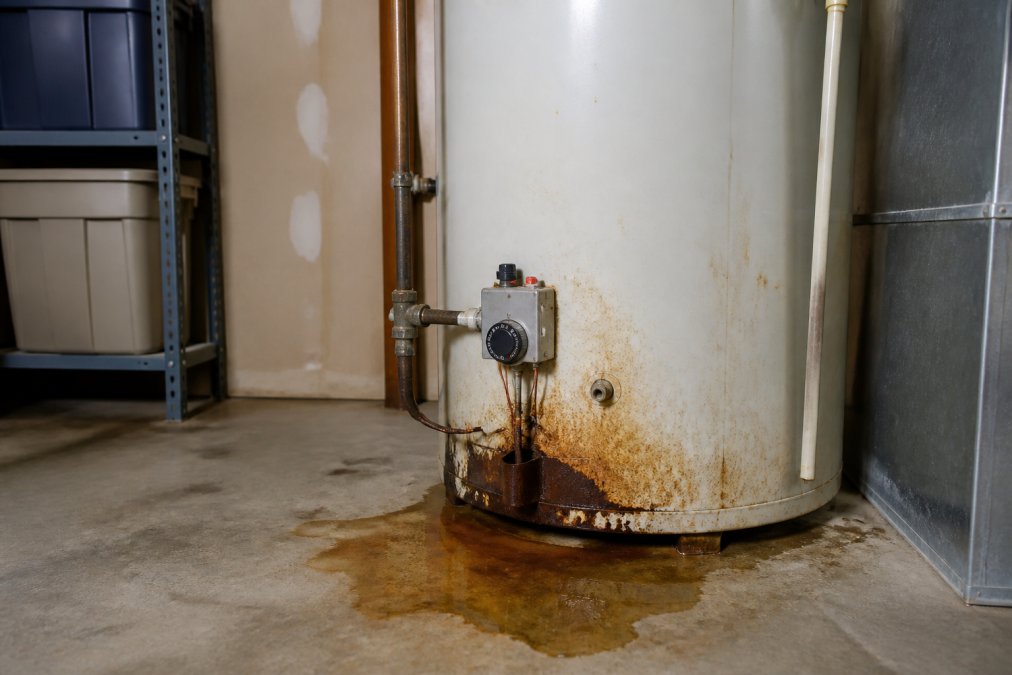
Water heater leaking from bottom is the one sign you should never treat as minor. A small puddle near the base usually means the tank shell has corroded through, not a loose fitting.
Check whether the moisture comes from the top connections or the tank body. Top fittings and the T&P valve can sometimes be resealed; a leak from the tank bottom cannot.
3. Rusty or Discolored Hot Water
Rusty water from the hot tap points to the heater. If cold water runs clear and hot water comes out brown or yellow, corrosion is happening inside the tank.
Rust streaks on the tank exterior tell the same story. Once the glass lining fails, the steel underneath reacts with your water supply and the tank degrades from the inside out.
4. Knocking, Popping, or Rumbling Noises
Popping noises mean sediment buildup. Minerals settle on the burner plate and tank bottom, trapping water underneath; when that water boils, it pops.
Knocking sounds often point to thermal expansion or a failing heating element cycling on and off. Either way, the heater is working harder than it should.
5. Inconsistent Water Temperature and Lukewarm Showers
Lukewarm water that never quite gets hot is a classic sign of a failing heating element or a drifting thermostat. In gas units, a worn thermocouple can shut the burner down mid-cycle.
If your shower swings between scalding and cold, the dip tube may have broken. That tube pushes cold water to the tank bottom; when it fails, hot and cold mix unpredictably.
6. Less Hot Water and Slower Recovery
Decreased hot water output usually means sediment has eaten into your effective capacity, or the heating element is failing.
Hot water recovery rate is how fast the unit reheats after you drain it. A tank that once handled three back-to-back showers and now struggles with one has lost meaningful capacity. That's a strong signal to start pricing a replacement.
7. Smelly or Metallic-Tasting Water
A metallic odor or taste in hot water points to anode rod failure. That rod is a sacrificial component designed to corrode before the tank does.
When the rod is spent, corrosion attacks the tank walls instead. A rotten-egg smell is separate, usually bacteria reacting with the magnesium rod, and can sometimes be fixed by switching rod material.
8. Visible Corrosion, Rust Streaks, or a Failing Pressure Relief Valve
The pressure relief valve is a safety device and should never be ignored (osha.gov). If it's dripping, stuck, or discharging constantly, the tank is under excess pressure from thermal expansion.
Corrosion at the fittings, rust streaks down the side, or a valve that won't seal all point to the same conclusion. The unit is at the end of its service life, and the risk of a burst tank climbs every month.
The Average Lifespan of a Water Heater (and What Shortens It)
Maintenance decides the lifespan of a water heater.
Hard water is the biggest lifespan killer: scale coats the heating element, forces the unit to run longer, and accelerates corrosion (Purchasing Energy-Efficient Residential Water Heaters). Skipping annual flushing and never checking the anode rod shortens life further.
Tank vs Tankless: Warning Signs That Are Unique to Each Type
Most guides assume you own a traditional tank. If you own a tankless unit, half the standard advice doesn't apply, tankless heaters rarely leak, and a puddle usually means a plumbing issue, not a failed heat exchanger. Here's how the failure modes differ.
Signs Specific to Tank-Style Water Heaters
Tank integrity is everything. The steel shell is lined with glass, and once that lining cracks, the tank corrodes from the inside out. Watch for:
- Puddling at the base. Moisture at the bottom, not the top fittings, almost always means the shell has failed. Top connections and the T&P valve can sometimes be resealed; the tank body cannot.
- Rust streaks on the shell or at the fittings. External rust is a visible symptom of internal corrosion.
- A rising energy bill with no change in use. Sediment on the burner plate insulates water from the flame, so the unit runs longer to hit the same temperature.
- Popping or rumbling during heating. Mineral scale traps water under the burner, and that water boils, the sound of the tank working harder than it should.
- Hot water that runs out faster than it used to. Sediment eats into effective capacity.
- A dripping or stuck T&P valve. This safety device discharging constantly means excess pressure from thermal expansion, often a waterlogged or missing expansion tank.
A tank leaking from the bottom is done, no repair reverses shell corrosion.
Signs Specific to Tankless Water Heaters
Tankless units fail differently. They don't store water, so they don't rust from the inside, but they scale up, and the heat exchanger is far less forgiving of mineral buildup than a tank.
- Cold water that never reaches temperature. The most common tankless complaint: scale on the heat exchanger reduces heat transfer, so the unit can't hit setpoint at your demanded flow rate.
- Error codes on the display. Codes for flame failure, ignition, or outlet temperature usually mean the heat exchanger or flow sensor needs attention.
- Reduced flow at the tap. Scale narrows the water passages inside the unit. If shower pressure drops and the aerator is clean, the restriction is likely inside the heater.
- Fluctuating temperature at the tap. A tankless unit modulates its burner to hold temperature; if it swings hot and cold, the flow sensor or mixing valve is often the culprit.
- Ignition or flame failure on gas units. A dirty flame rod or failing igniter shuts the burner down. This is a service call, not a DIY fix.
- A leak inside the unit. Tankless leaks are usually at the fittings or heat exchanger. Heat exchanger leaks from freeze damage or scale are often terminal.
The Maintenance Difference
The maintenance schedule is where tank and tankless diverge:
| Task | Tank | Tankless |
|---|---|---|
| Flush / descale | Annually | Annually, or every 6 months with hard water |
| Anode rod check | Annually | Not applicable, no tank to protect |
| T&P valve test | Monthly | Not applicable on most models |
| Scale inspection | Sediment on burner plate | Heat exchanger and inlet filter |
| Typical lifespan | 8-12 years | Up to 20 years with descaling |
Tankless units live longer than tanks, but only if you descale them. Skip annual descaling on hard water and a 20-year unit can drop to 10.
Which Type Are You Actually Looking At?
If you're not sure which unit you own, look at the shape. A tank is a tall cylinder, usually in a basement, garage, or utility closet. A tankless unit is a wall-mounted box, roughly the size of a carry-on suitcase, with water and gas or electrical lines running into it.
What This Means for Your Decision
If you own a tank leaking from the base, you're replacing it. If you own a tankless unit throwing error codes or running cold, descale it first, scale is often the only problem, and descaling costs a fraction of a new unit. Only after descaling fails should you price a replacement.
What It Costs to Replace a Water Heater (and How to Decide Repair vs Replacement)
Here's how homeowners can decide between repair and replacement.
Typical Installed Costs
Installed cost is the unit plus labor, permits, and code upgrades.
| Job | Typical Installed Cost | Notes |
|---|---|---|
| 40-50 gallon gas tank, like-for-like swap | $1,200 - $2,000 | Cheapest path if venting and gas line already exist |
| 40-50 gallon electric tank, like-for-like swap | $1,100 - $1,800 | May need a dedicated 240V circuit |
| Tankless gas, new install | $3,000 - $6,500 | Often requires upsizing the gas line and new venting |
| Tankless electric, new install | $2,500 - $5,000 | Frequently needs a panel upgrade |
| Expansion tank add-on | $250 - $500 | Required in many jurisdictions on closed systems |
| Permit | $50 - $300 | Varies by municipality |
These are national ranges. High-cost metros and older homes with code catch-up work land at the top or above. Get two written quotes and compare line items, not just totals.
The 50% Rule
If the repair quote exceeds 50% of a new installed unit, replacement is often recommended.
The Age Multiplier
When Repair Is Almost Never Worth It
Some failures are terminal regardless of age:
- Leaking from the tank body or base. The steel shell has corroded through. No patch, sealant, or weld holds. Replace.
- Rust-colored or metallic hot water with a spent anode rod. Once the tank wall is the sacrificial component, corrosion is underway.
- A cracked or leaking tankless heat exchanger. Scale damage that far along usually isn't recoverable.
- Repeated element or thermocouple failures on the same unit. One failure is a part. Three in two years is a system problem.
When Repair Makes Sense
- A single failed heating element, thermocouple, or thermostat on a unit under 8 years old
- A dripping temperature and pressure relief valve that reseals after a flush
- A failed dip tube on an otherwise sound tank
- Tankless error codes and reduced flow that resolve after descaling
The Hidden Costs of Waiting
A tank that fails catastrophically releases its full capacity onto the floor. Water damage remediation can be costly. If a unit shows two or more warning signs above, replacing it on your schedule can prevent more significant issues.
Questions to Ask Before You Sign
- Is the price for the unit, labor, permit, and haul-away, or just the unit?
- Does the quote include a new expansion tank if needed?
- Will the installer pull the permit, or are you?
- What's the labor warranty, separate from the manufacturer's tank warranty?
- If venting or gas line work is required, is that in the number?
A quote that skips the permit or the expansion tank may lead to future issues.
A Simple Water Heater Maintenance Schedule That Extends Lifespan
Water heater maintenance is important:
- Monthly: Test the pressure relief valve by lifting the lever and letting it snap back.
- Every 6 months: Check for moisture, rust streaks, and corrosion at the fittings.
- Annually: Flush the tank to clear sediment buildup, and inspect the anode rod.
- Every 2-3 years: Have a professional inspect the heating element, thermocouple, and expansion tank.
A thermal expansion tank absorbs pressure spikes as water heats.
Your 10-Minute DIY Water Heater Inspection Checklist
A quick inspection can help identify problems. Grab a flashlight and work through this list.
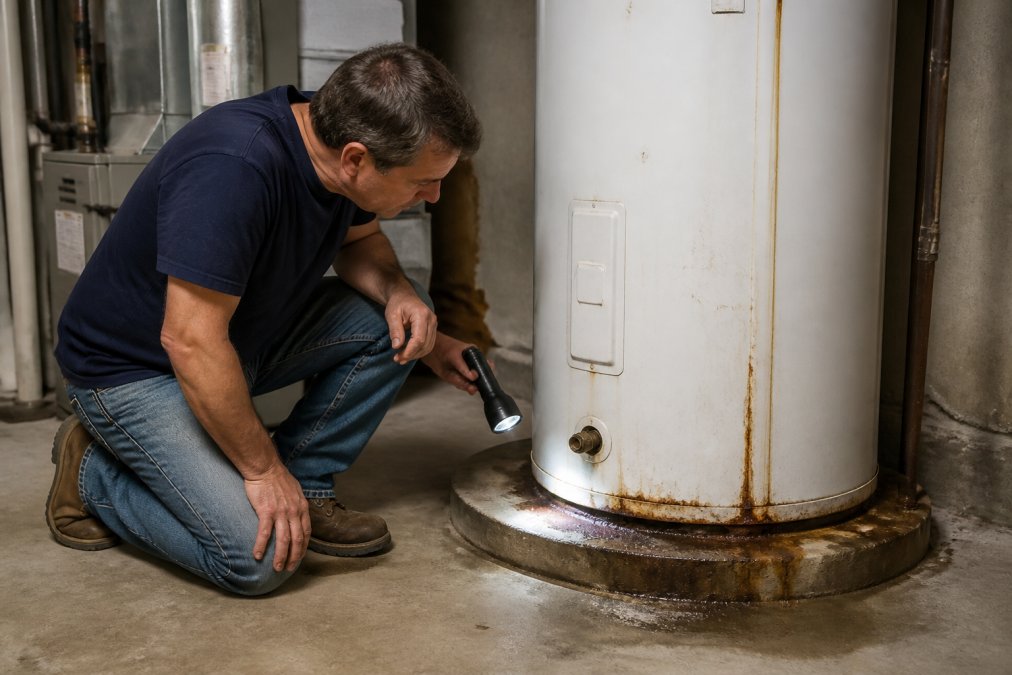
- Check the base of the tank for puddling or moisture
- Look for rust streaks on the shell and at the fittings
- Test the pressure relief valve and confirm it reseats
- Listen for popping, knocking, or rumbling while it runs
- Run hot water at two taps and check the temperature
- [ ]
- Note the manufacture date from the serial number
- [ ]
If issues are flagged, it's time for a professional plumbing inspection.
When to Call a Professional for Water Heater Replacement
Call a professional the moment you see water pooling at the base, smell gas, or find the pressure relief valve discharging. These aren't DIY fixes.
Gas water heater work involves the gas control valve, venting, and combustion air, and mistakes are a safety issue. Electric replacements may need a dedicated circuit and permit. A licensed plumber confirms venting, checks for thermal expansion issues, and installs to code.
At England's Plumbing & Heating, we've handled water heater installation and repair across Chester County since 1989, along with gas piping and water conditioning work. If your unit shows any of the signs above, our team can inspect it, walk you through repair versus replacement, and handle the install. Book online when you're ready.
Frequently Asked Questions
How long does a water heater last, and how do I know I'm near the end?
If you're noticing rusty water, popping noises, or puddling around the base, replacement may be a smart move. Hard water speeds up sediment buildup. A quick check of the manufacturer's label on the tank tells you the exact age.
What are the most common signs water heater needs replacement?
The clearest signs are a tank that's leaking from the bottom, rusty or metallic-smelling hot water, rumbling or popping sounds from sediment, and inconsistent temperatures. If you're also running out of hot water faster than usual, those combined signals point to replacement rather than repair. Any leak from the tank itself is usually the final sign, since the steel is already compromised.
How much does it cost to replace a water heater?
The cost to replace a water heater depends on the unit type, size, fuel source, and whether venting or electrical upgrades are needed. Labor and permits are separate, so request a written quote for an accurate total.
Should I repair or replace my aging water heater?
If the repair cost is more than half the price of a new unit, or if the heater is older, replacement usually makes more financial sense. A leaking tank, severe corrosion, or a failed heat exchanger cannot be repaired. For a single failed heating element or thermocouple, a repair is often worth it.
Is water heater leaking from bottom always a sign I need a new one?
A leak from the bottom of the tank itself usually means the steel has corroded through, and that cannot be patched. However, sometimes the leak is just a loose drain valve, a failing pressure relief valve, or a bad fitting on the cold-water inlet. Wipe the area dry, watch where water reappears, and call a licensed plumber to confirm whether it's a simple fix or a full replacement.
Two or three warning signs together usually mean the tank is finished, not just tired. England's Plumbing & Heating handles water heater installation, repair, gas piping, and water conditioning for homeowners across the area, with online booking and live chat to schedule around your day. Get started with England's Plumbing & Heating and replace the guesswork with a straight answer on repair versus replacement.