 how-to
How to Choose the Right Water Softener Salt
Table of Contents
- Start With Your Softener Manual and Water Test
- Water Softener Salt Pellets vs Crystals: Key Differences
- How to Find the Best Salt for Water Softener Performance
- How Much Salt Does a Water Softener Use?
- How Often to Add Salt to a Water Softener
- Troubleshooting Salt Problems: Bridges, Mushing, and Residue
- Symptom: Water Suddenly Feels Hard Again
- Symptom: Tank Looks Full but Salt Never Seems to Drop
- Symptom: Sludge or Mushing at the Bottom of the Tank
- Symptom: White Residue or Sediment in the Brine Tank
- Symptom: Spotting, Soap That Will Not Lather, or Scale on Fixtures
- Symptom: Softener Uses More Salt Than Usual
- Frequently Asked Questions
Last Updated: October 19, 2026
Start With Your Softener Manual and Water Test
The fastest way to choose the right water softener salt is to open your owner's manual before you buy anything. Manufacturers list approved salt types and warn against the ones that can void your warranty. That single page settles most of the debate for you.
Water softener salt is a high-purity sodium chloride product used to recharge the resin beads inside a salt-based softener. Hard water minerals, mainly calcium and magnesium, collect on those beads during normal use. Salt makes the brine that washes them clean during regeneration.
At England's Plumbing & Heating, we have handled water conditioning calls across Chester County since 1989.
So start here:
- Find the salt type your manual approves.
- Test your water for hardness, iron, and manganese.
- Note your household size and daily water use.
- Check the brine tank size and bag capacity.
A basic water test matters more than most people think. High iron or manganese changes which salt and which softener settings work best. If your water comes from a private well, test it every year. The EPA's guidance on private well testing explains what to check and how often.
Water Softener Salt Pellets vs Crystals: Key Differences
Pellets and crystals both soften water. The difference is how they are made and how they behave in the brine tank.
Evaporated salt is mined salt dissolved and recrystallized. That process strips out most impurities, so it reaches very high sodium chloride purity. Solar salt comes from evaporated seawater and is sun-dried. It is cheaper but carries more trace minerals.
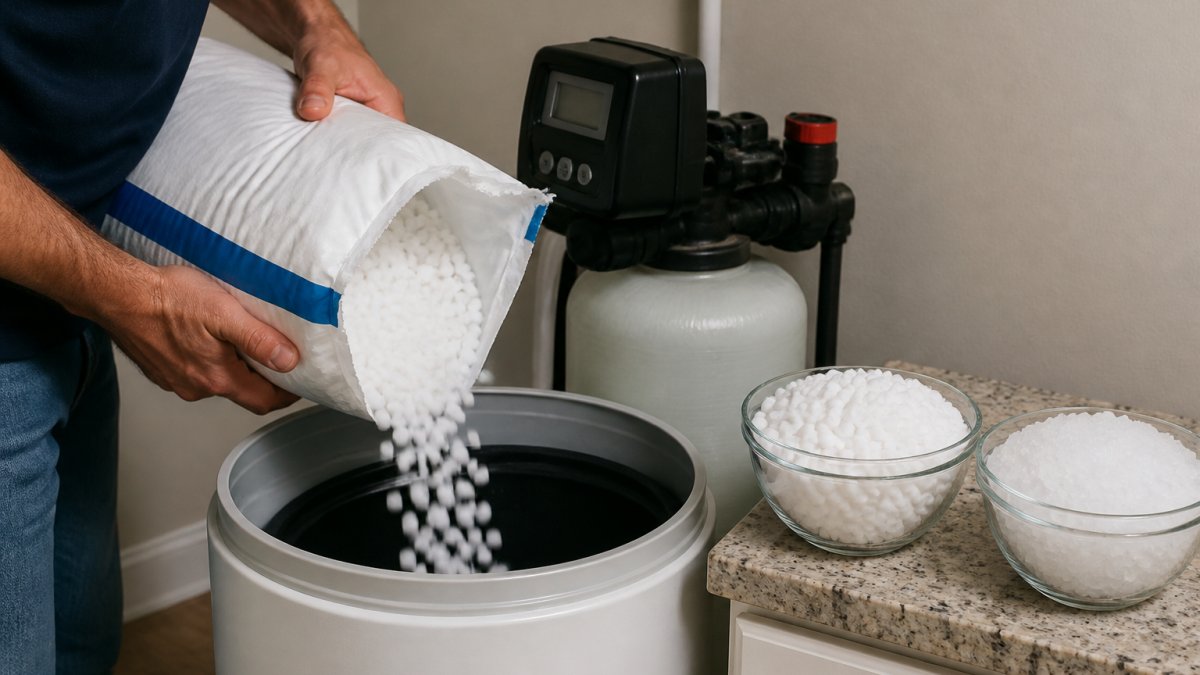
Here is how the two main forms compare:
| Feature | Pellets | Crystals |
|---|---|---|
| Purity | High | Moderate to high |
| Dissolving speed | Slower, steady | Fast |
| Residue risk | Lower | Higher |
| Best for | Most homes | Fast refills, tight budgets |
| Cost | Higher per bag | Lower per bag |
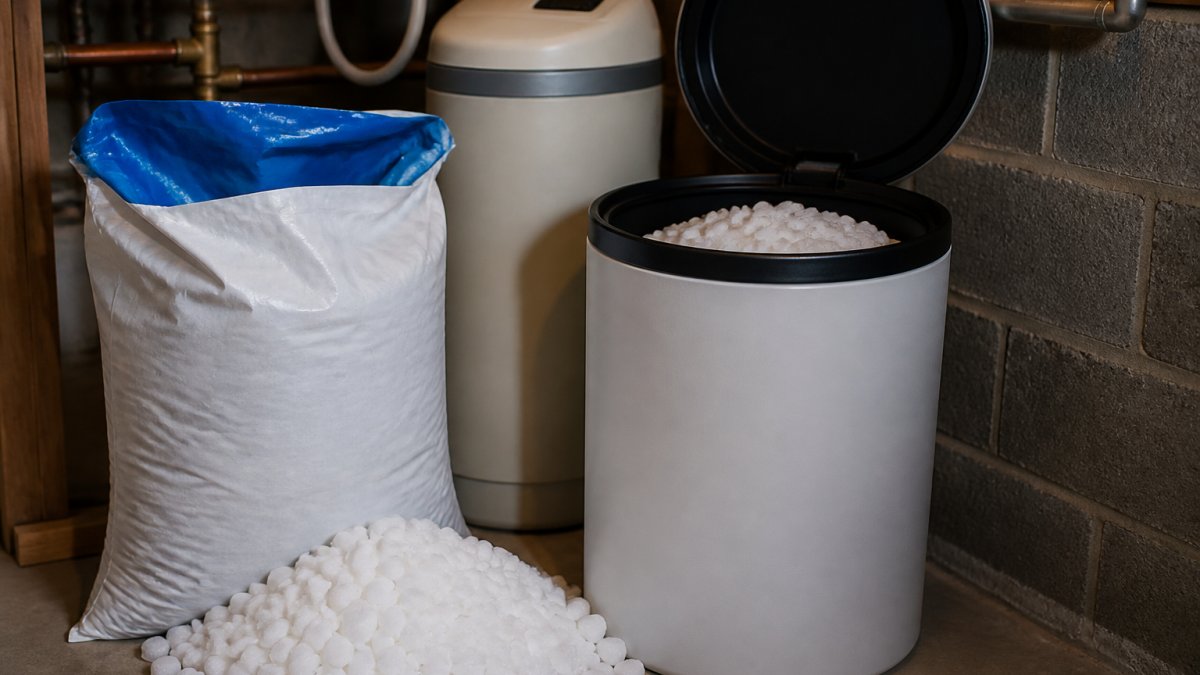
Pellets are pressed and hold up well in humid basements. Crystals dissolve quickly and can leave more sediment over time. Rock salt is the crudest option and is best avoided in most modern softeners.
How to Find the Best Salt for Water Softener Performance
The best salt for water softener performance is high-purity evaporated salt that matches your manual and your water chemistry. Purity means less residue, fewer cleanouts, and steadier regeneration.
Work through this decision path:
- Check the manual. Follow the approved salt type first.
- Test the water. High iron points toward a cleaner, higher-purity salt and an iron-fighting additive.
- Match the household. A large family cycles the softener more often and needs steady, reliable salt.
- Weigh cost against cleaning. Cheap salt saves money up front and can cost more in maintenance.
A common mistake is buying rock salt to save a few dollars. It leaves more insoluble material behind, and that material builds up in the brine tank. Over time you are scooping out sludge instead of adding salt.
What most guides miss is the warranty angle. Many softener makers specify approved salt types, and using the wrong one can affect coverage. Keep your manual and your salt receipts.
If you are unsure which salt suits your system, our team can test your water and check the softener settings. NSF/ANSI 44 certification for water softeners is a useful reference for how softeners are rated.
How Much Salt Does a Water Softener Use?
Most homes use roughly 40 to 80 pounds of salt per month, but the real number depends on hardness, water use, and softener settings. A family of four on very hard water sits near the top of that range; a two-person household on moderately hard water often lands near the bottom.
Salt consumption rises with:
- Higher water hardness (measured in grains per gallon, or gpg)
- More people in the home
- Older or less efficient softener settings
- Frequent regeneration cycles
- High iron or manganese, which can force extra regeneration
A softener that regenerates every day will burn through salt far faster than one set to regenerate on demand. That is why a quick settings check often saves more than switching salt brands ever will.
Estimate Your Annual Salt Use
You can get a working number without a meter by combining three inputs:
- Hardness in gpg. A basic test strip or lab result gives you this. Under about 3 gpg is soft; 7-10 gpg is hard; above 10 gpg is very hard.
- Daily water use. A common planning figure is about 75-100 gallons per person per day for indoor use.
- Softener efficiency. Newer demand-initiated softeners use noticeably less salt per regeneration than older timer-based units.
Multiply household daily gallons by hardness, then divide by the softener's rated capacity per regeneration to see how often it cycles. Each regeneration typically draws several pounds of salt, so cycle frequency drives your monthly total more than bag size does.
Think in Cost Per Year, Not Cost Per Bag
A cheaper bag that dissolves poorly and leaves residue can cost more over a year than a higher-purity bag that dissolves cleanly. Track your refills for two months to see your true salt consumption, then multiply to a yearly figure.
When you compare salt by annual cost, include:
- Bag price and bag weight. A 40-pound bag is the common retail size; compare price per pound, not price per bag.
- Refill frequency. More refills per year means more trips, more handling, and more chances to introduce moisture.
- Delivery charges. Bulk or delivered salt can carry a fee that erases a lower shelf price.
- Maintenance cost. Residue-prone salt means more tank cleanouts and possibly more service calls.
A simple worksheet: (pounds per month × 12) ÷ pounds per bag = bags per year. Multiply by price per bag, then add delivery and any cleanout costs. That total is the number worth comparing, not the sticker on the shelf.
Refill Frequency by Household Size
As a rough guide, a two-person home on moderately hard water may refill every six to eight weeks, while a family of four on very hard water may refill every four to five weeks. If you are refilling far more often than that, check the hardness setting and regeneration schedule before blaming the salt.
How Often to Add Salt to a Water Softener
Check the salt level in the brine tank every month, and top it up when it drops to about one-third full. Most homes need a refill every four to eight weeks.
A simple routine keeps things running:
- Monthly: look at the salt level and break up any crust.
- Every refill: check for bridges or mushing before adding more.
- Yearly: test the water and review the settings.
Never fill the brine tank to the top. Leave room for the brine to form, and follow the fill line if your tank has one. Salt level matters less than salt condition.
Troubleshooting Salt Problems: Bridges, Mushing, and Residue
Most salt-related softener trouble shows up as a symptom first. Use this symptom-to-cause guide to trace the problem back to salt choice or maintenance before you call for service.
Symptom: Water Suddenly Feels Hard Again
Likely causes: a salt bridge, an empty or low brine tank, or a softener that is not regenerating.
- Salt bridge. A hard crust forms and holds the salt above the water. The tank looks full but no brine forms. Break it with a broom handle and switch to a cleaner, higher-purity salt.
- Low salt. Check the actual level, not just the top of the tank.
- Regeneration failure. Confirm the unit is cycling on schedule; a power interruption or a stuck valve can stop regeneration without any salt problem at all.
Symptom: Tank Looks Full but Salt Never Seems to Drop
This is the classic salt bridge signature. The salt has crusted into a shelf above the brine. Probe the salt with a broom handle, if it resists or you hit a hollow gap, you have a bridge. Break it up, remove the crust, and consider pellets over crystals in a damp basement.
Symptom: Sludge or Mushing at the Bottom of the Tank
Likely causes: excess moisture, cheap or impure salt, or overfilling the brine tank.
Salt mushing turns the bottom of the tank into sludge that will not dissolve. Scoop it out, clean the tank, and stop filling above the fill line. Higher-purity evaporated salt and pellets reduce the risk.
Symptom: White Residue or Sediment in the Brine Tank
Likely causes: insoluble material from lower-purity salt, especially rock salt or solar salt with high trace mineral content.
Residue buildup collects in the tank and can clog the brine valve. Higher-purity evaporated salt reduces this. If you already have buildup, empty and clean the tank before adding new salt.
Symptom: Spotting, Soap That Will Not Lather, or Scale on Fixtures
These usually trace back to a brine problem, not the softener itself. Check the salt first, then the hardness setting, then the regeneration schedule. If the cause is not obvious, a water test and a system inspection will find it faster than guessing.
Symptom: Softener Uses More Salt Than Usual
Likely causes: a hardness setting that is too high, frequent regeneration from high iron or manganese, or a failing brine valve. Recheck the water test and the settings before switching salt brands.
If your water turns hard again after a refill, check the salt first. Symptoms like hardness, spotting, and soap that will not lather usually trace back to a brine problem, not the softener itself. Our team at England's Plumbing & Heating can inspect the system and test the water if the cause is not obvious.
Frequently Asked Questions
Does it matter what salt I use in my water softener?
Yes, it matters. The wrong salt can cause bridging, mushing, or residue that damages the resin beads and reduces efficiency. Always check your softener manual for manufacturer recommendations. Most systems work well with high-purity pellets or crystals, but some require specific types. Using table salt is never recommended because additives can harm the unit. If you have iron or manganese in your water, choose a salt formulated for those conditions. When in doubt, ask a professional or test your water first.
How long should a 40 lb bag of salt last in a water softener?
A 40 lb bag typically lasts 4 to 8 weeks for a family of four, depending on water hardness and household water use. Softer water and smaller families may stretch a bag to 10 weeks, while very hard water or high consumption can use it in 3 weeks. Monitor your salt level monthly and adjust based on your system's consumption. Keeping a log helps you spot changes that might indicate a problem.
Can I use table salt in a water softener?
No. Table salt contains additives like iodine and anti-caking agents that can foul the resin beads and damage the softener. It also dissolves too quickly, leading to inconsistent brine concentration. Always use salt specifically labeled for water softeners, such as pellets, crystals, or block salt. These are designed for ion exchange and leave minimal residue. Using the wrong salt can void your warranty and lead to costly repairs.
Hard water and softener trouble rarely fix themselves, and guessing at salt types can cost you time and money. At England's Plumbing & Heating, we test your water, inspect your softener, and recommend the right salt and settings for your home. Our team has served Chester County since 1989 with water conditioning, well pump service, and water heater work. Book online with England's Plumbing & Heating and get your water soft again.