 listicle
Benefits of Annual Water Heater Maintenance
Last Updated: October 22, 2026
Quick Summary
Annual water heater maintenance pays off because a tank that gets looked at once a year often outlasts one that doesn't. The visit flushes sediment, tests the relief valve, and checks the anode rod, which slows the corrosion and sediment buildup that kill tanks. Documented service also supports warranty claims.
- Flush a tank water heater once a year as the baseline for most homes.
- Hard water, heavy demand, or a private well means flushing every six to nine months.
- Replace the anode rod once it is more than half consumed.
- A leaking tank cannot be repaired because corrosion reaching the steel is permanent.
- Keep every service receipt, since documented maintenance supports warranty claims.
Table of Contents
- Why Annual Water Heater Maintenance Pays Off
- Water Heater Maintenance Checklist: What Gets Done and Why
- How Often to Flush a Water Heater (and What Changes the Schedule)
- Water Heater Maintenance Cost: DIY vs. Professional Service
- Tankless Water Heater Maintenance: What's Different
- Warning Signs That Maintenance Is Overdue
- How Annual Service Extends Water Heater Life and Efficiency
- Conclusion
- Frequently Asked Questions
Why Annual Water Heater Maintenance Pays Off
Benefits of annual water heater maintenance come down to one thing: a tank that lasts longer and a bill that stays lower. Units that get looked at once a year often outlast the ones that don't.
Here's the uncomfortable part. A water heater is the one appliance in your home that runs every single day, usually without anyone thinking about it.
Most homeowners only call someone when the water runs cold or a puddle appears in the basement. By then, the damage is done.
The Real Cost of Neglect
Sediment is the quiet problem. Minerals in the water settle at the bottom of the tank and form a layer between the burner and the water. That layer forces the system to work harder to heat the same amount of water. It also creates hot spots on the tank floor that speed up corrosion.
A common mistake is assuming a new-looking heater is a healthy one. Rust starts inside, where you can't see it.
Water Heater Maintenance Checklist: What Gets Done and Why
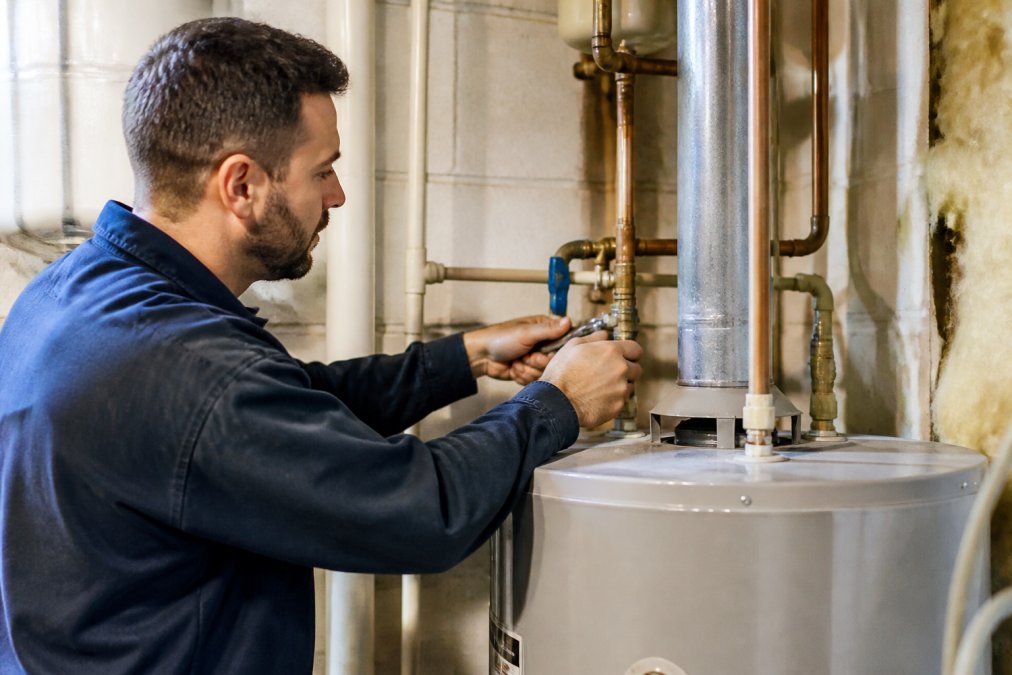
A proper water heater maintenance checklist covers six core tasks, and each one targets a specific failure point. Here's what a thorough annual visit includes.
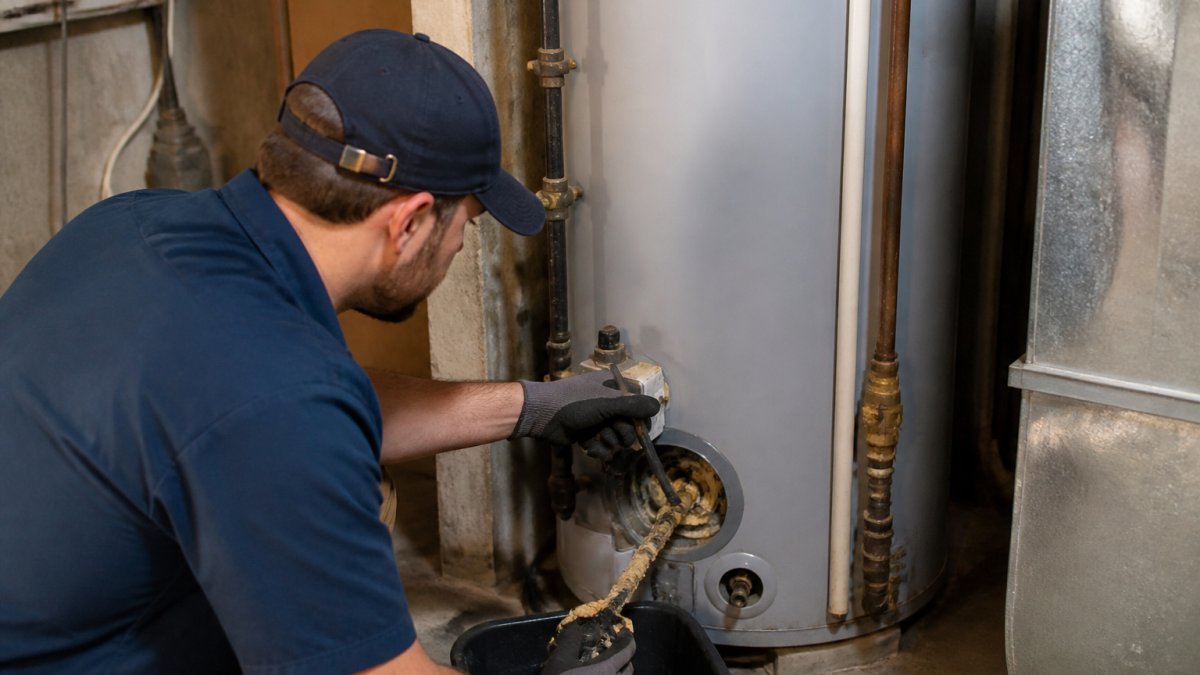
- Flush the tank to clear sediment buildup from the bottom.
- Test the temperature and pressure relief valve to confirm it opens and reseats correctly.
- Inspect the anode rod and replace it if it's more than half consumed.
- Check the thermostat and confirm the water temperature sits in a safe range.
- Look for leaks, rust, and corrosion at the fittings, drain valve, and tank seams.
- Examine the burner, gas supply, or heating elements depending on the system type.
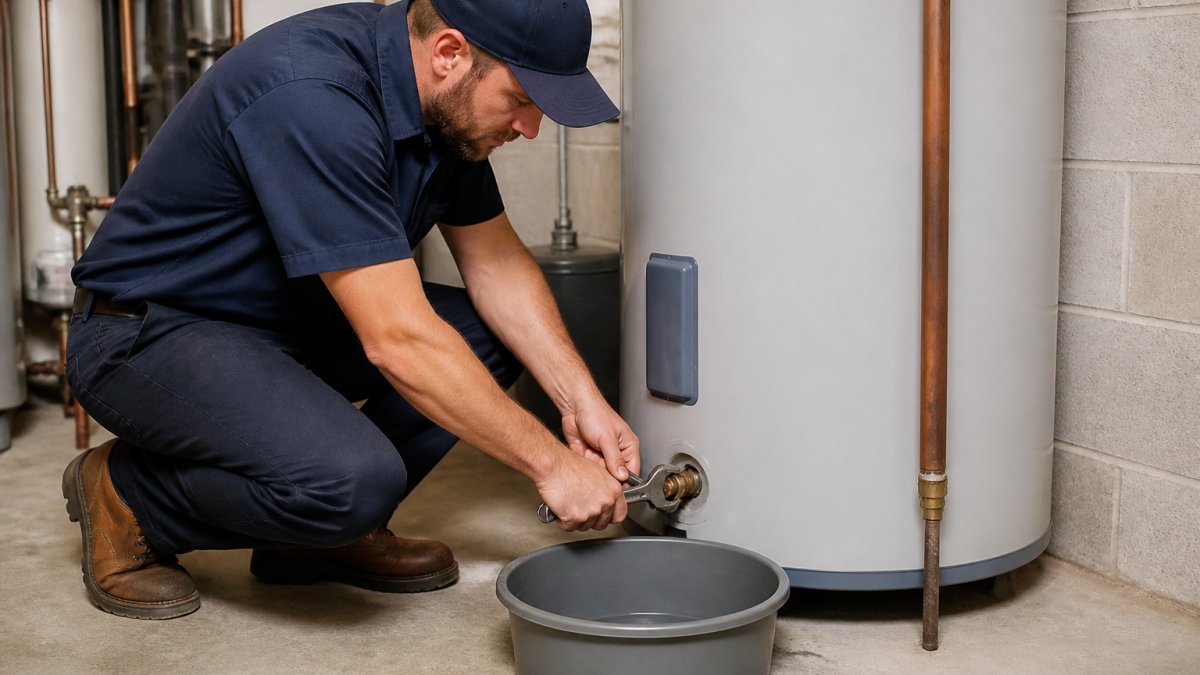
Why each task matters: the anode rod is a sacrificial metal that corrodes so your tank doesn't. Once it's gone, the tank itself becomes the sacrifice.
How Often to Flush a Water Heater (and What Changes the Schedule)
Flush a tank water heater once a year in most homes. That's the baseline, and it covers the majority of households with moderate water use.
The schedule shifts with your conditions. Hard water carries more dissolved minerals, so sediment builds faster. Households with heavy hot water demand, like large families or homes with multiple bathrooms in constant use, should consider flushing every six to nine months.
Hard Water, Heavy Use, and Other Factors
Water hardness is the biggest variable. If you've noticed scale on faucets or spots on dishes, your water is telling you something about the inside of your tank too.
Usage matters just as much. A two-person household and a family of six put very different demands on the same tank.
Private well systems deserve extra attention. Well water often carries more minerals and sediment than treated municipal supply, which means the flush interval should be on the shorter end.
Water Heater Maintenance Cost: DIY vs. Professional Service
Water heater maintenance cost depends on what's being done and who does it. A basic flush is something a confident homeowner can handle with a hose, a bucket, and some patience. Anode rod replacement, relief valve testing, and burner inspection are a different story.
Here's how to frame the decision:
| Task | DIY Friendly? | Why |
|---|---|---|
| Flushing the tank | Yes, with care | Needs a hose, bucket, and correct shutoff sequence |
| Testing the relief valve | Caution | A valve that won't reseat can leak or fail |
| Replacing the anode rod | No | Requires the right rod type and proper torque |
| Thermostat adjustment | Yes | Simple dial or panel setting on most units |
| Burner or element inspection | No | Gas and electrical components carry real risk |
| Leak and corrosion check | Yes | Visual inspection you can do yourself |
What Drives the Price of a Professional Visit
A routine annual service call typically bundles the flush, anode rod inspection, relief valve test, and visual inspection into one visit. The price varies with three things: system type (tank versus tankless), access (a basement with a floor drain is easier than a closet with no drain), and whether parts are needed.
Most homeowners find the annual visit costs less than an emergency replacement. That's the real comparison, not the service fee against zero, but the service fee against a mid-winter failure with water on the floor.
When Repair Stops Making Sense
A common pattern: once a tank is past roughly two-thirds of its expected service life and needs a repair beyond routine maintenance, replacement often wins on total cost. A leaking tank cannot be repaired, corrosion that reaches the steel is permanent. A failed heating element or thermostat on an otherwise sound tank is usually worth fixing. Ask the technician to state the age of the unit and the cost of the repair before you decide.
Gas supply work is not a DIY job. If you smell gas or hear hissing near the unit, shut off the gas and call a professional. That's a safety issue, not a maintenance task.
Tankless Water Heater Maintenance: What's Different
Tankless water heater maintenance focuses on descaling rather than flushing sediment.
The process uses a pump and a descaling solution to circulate through the unit and dissolve mineral buildup. In hard water areas, tankless units often need descaling once a year.
Other tankless tasks include cleaning the inlet filter screens and checking the air intake and exhaust for blockages. Gas models also need a combustion check.
The trade-off is real. Tankless units avoid the standby heat loss that tank models have, but they demand more attentive maintenance.
Warning Signs That Maintenance Is Overdue
Warning signs that maintenance is overdue usually show up before a full failure. Catching them early is the difference between a service call and a replacement.
- Popping or rumbling sounds from the tank, which point to sediment trapping steam underneath.
- Hot water running out faster than it used to, a sign of reduced recovery time.
- Discolored or rusty hot water, which can mean internal corrosion.
- Moisture or rust around the base of the tank.
- A relief valve that drips or won't seal.
- Rising energy bills with no change in usage.
Any one of these is worth a call. Two or more together usually means the system has been neglected for a while.
How Annual Service Extends Water Heater Life and Efficiency
Annual service extends water heater life by slowing the two things that kill tanks: corrosion and sediment. Replace the anode rod when it's spent, and the steel tank stays protected. Flush the sediment, and the burner stops overheating the tank floor. Those mechanisms are well understood. Here's what the evidence actually supports.
What's Well-Supported
- Anode rod replacement protects the tank. The rod is sacrificial by design; once it's consumed, the tank becomes the anode. Replacing it on schedule is the single most direct way to delay tank failure.
- Sediment removal restores heat transfer. A sediment layer insulates the burner from the water, forcing longer run times. Flushing removes that layer, and recovery time improves.
- Relief valve testing prevents a safety failure. A stuck valve is a genuine hazard, and testing it is cheap insurance.
- Documented maintenance supports warranty claims. Manufacturer warranties commonly require proof of service, and a denied claim turns a covered replacement into a full out-of-pocket cost.
What's Plausible but Not Guaranteed
Energy savings from a flush are real but modest, and they scale with how much sediment had built up. A tank that was heavily scaled will show a clearer improvement than one that was maintained all along. Expect the effect on the bill to be gradual, not dramatic.
A common pattern is that tanks that get annual attention tend to reach the upper end of their expected service life, while neglected tanks fail early. That's a tendency, not a promise.
The Tank Versus Tankless Trade-Off
Tankless units avoid standby heat loss, which is a genuine efficiency advantage. But they concentrate maintenance risk in the heat exchanger, scale there cuts efficiency quickly, and descaling is not optional in hard water. A tankless owner who skips service may see efficiency erode faster than a tank owner who skips a flush. The efficiency edge is real, but it's conditional on keeping up with descaling.
Manufacturer warranties also tend to favor documented maintenance. Keep your service records.
Conclusion
The challenge with water heater maintenance is that nothing feels urgent until it is. A flush and an inspection take little time, but they prevent the failures that cost the most.
England's Plumbing & Heating has handled water heater installation, repair, and routine service for homeowners across Chester County since 1989. We also handle gas piping and water conditioning if hard water is part of your problem.
Book online with England's Plumbing & Heating and get your water heater on a maintenance schedule before the next cold morning catches you off guard.
Frequently Asked Questions
What are the benefits of annual water heater maintenance?
Annual water heater maintenance keeps sediment from building up, which protects the tank and heating elements and helps the system run closer to its rated efficiency. It also gives a technician the chance to catch small leaks, a failing anode rod, or a stuck pressure relief valve before they turn into expensive repairs. Regular service can extend the tank's service life and reduce the chance of a sudden breakdown when you need hot water most.
How often should I flush my water heater?
Most manufacturers recommend flushing the tank once a year. If you have hard water, you may need to flush every six to eight months because mineral deposits accumulate faster. Homes with high household hot water demand or a tank that is already several years old also benefit from a shorter interval. A water heater maintenance checklist from your manufacturer will give the exact schedule for your model.
Can I flush my water heater myself?
Yes, flushing a tank water heater is a doable DIY task if you are comfortable shutting off the power or gas, connecting a hose to the drain valve, and letting the tank empty. The job takes about 30 to 60 minutes. However, if you have never worked around a gas valve or you are unsure how to relight a pilot, professional service is safer. A technician can also inspect the anode rod and pressure relief valve at the same visit.
What does water heater maintenance cost?
Professional water heater maintenance cost varies by system type, location, and what the visit includes. Pricing depends on your specific setup, so request a quote from a licensed provider. DIY flushing costs only your time and a garden hose, but it does not include a technician's inspection of safety components.
Sources consulted: U.S. Department of Energy guidance on water heating, Environmental Protection Agency WaterSense program, and Consumer Product Safety Commission guidance on relief valves.