 how-to
How to Detect Hidden Gas Leaks in Walls Safely
Table of Contents
- Why Hidden Gas Leaks in Walls Are Hard to Spot
- Act First: What to Do If You Smell Gas
- Signs of a Gas Leak in a House You Can Observe Safely
- Gas Leak Symptoms Versus Other Household Odors and Sounds
- Step-by-Step: Checking for a Hidden Leak Without Opening Walls
- Gas Leak Detector for Home Use: What It Can and Cannot Tell You
- How Plumbers Find Gas Leaks Inside Walls
- Book a Licensed Gas Leak Inspection Before You Open a Wall
- Frequently Asked Questions
Last Updated: October 27, 2026
Why Hidden Gas Leaks in Walls Are Hard to Spot
Hidden gas leaks inside walls are among the most difficult home hazards to find. Natural gas is odorless in its pure form, so utilities add a chemical called an odorant that smells like rotten eggs.
The leak may be hidden behind drywall, under flooring, or inside a chase where pipes run between floors. Nothing looks wrong on the surface.
Here is what makes concealed leaks tricky:
- The gas can travel along the pipe before it reaches a noticeable spot
- Air movement can carry the smell away from the source
- Closed rooms and wall cavities can trap gas and hide the odor
Because of this, you should never rely on your nose alone to find a hidden leak.
Act First: What to Do If You Smell Gas
If you smell gas, act before you try to find the source. Your first job is safety, not detection.

Follow these steps right away:
- Leave the building now. Do not stop to investigate.
- Do not turn lights on or off, and do not use phones or electrical switches inside the home.
- Do not light matches, lighters, or candles.
- Get everyone outside, including pets.
- Call your gas utility's emergency line from a safe distance.
Your gas utility can shut off service at the meter if needed. Once you are outside and safe, a licensed plumber or gas technician should confirm the leak and repair it.
Signs of a Gas Leak in a House You Can Observe Safely
You can spot some signs of a gas leak without opening walls or touching gas fittings. Look and listen from a safe spot, and never test with flame.
Common signs include:
- A rotten-egg or sulfur-like smell, especially near floors or appliances
- A hissing or whistling sound near gas lines or appliance connections
- Dead or dying plants growing in a line above a buried gas pipe
Any one of these signs is reason to leave and call your gas utility. Do not wait to see if the problem goes away.
Gas Leak Symptoms Versus Other Household Odors and Sounds
Most gas-leak guides tell you to leave if you smell rotten eggs. That is correct, but it is not enough. Many household smells and sounds resemble a gas leak, and a guide that helps you tell them apart, without falsely reassuring you, is more useful than a simple checklist. The key is to understand what each signal actually is, then err on the side of safety when you are unsure.
Odors: what you are actually smelling
Natural gas is odorless; the rotten-egg smell comes from an odorant (typically mercaptan) added by the utility. That smell is distinctive, but it can be masked, diluted, or confused with other sources.
| What you notice | Likely source | Why it matters |
|---|---|---|
| Sharp rotten-egg or sulfur smell, strongest near an appliance, meter, or wall penetration | Odorized natural gas | Treat as a gas leak. Leave and call the utility. |
| Smell that appears only when a specific appliance runs, then fades | Appliance combustion or venting issue | Could be a gas leak at the appliance connection or a venting problem. Leave and call the utility. |
| Musty, damp, or earthy smell | Mold, mildew, or a water leak | Not gas, but worth investigating for moisture. |
| Burnt food, dust, or oily smell near a furnace | Dust burning off, or a combustion problem | Not the odorant smell, but a combustion issue can produce carbon monoxide. Ventilate and have the appliance checked. |
| Faint smell that comes and goes, hard to place | Gas migrating through a wall cavity, or a small intermittent leak | Do not dismiss it. Intermittent smells are common with concealed leaks. Leave and call the utility. |
| Smell of propane or a chemical solvent | Other fuels or products | Propane is also odorized; treat a strong fuel smell as an emergency. |
Sounds: what a hiss usually means
- Hissing or whistling near a gas line, meter, or appliance connection: This is a classic sign of gas escaping under pressure. Treat it as a leak. Leave and call the utility.
- Knocking or banging in water pipes: Usually water hammer or loose pipe supports, not gas. It is a plumbing noise, not a gas leak.
- Rattling or humming from an appliance: Often a fan, motor, or burner issue. Not by itself a gas leak, but a burner that sounds wrong should be checked.
- A faint hiss you cannot locate: Could be a small leak, an air leak, or a failing valve. If you cannot rule it out, leave and call the utility.
The uncertainty rule
If you are not sure whether a smell or sound is gas, treat it as gas. A false alarm costs you a call and some time outside. A missed leak can cause a fire, an explosion, or carbon monoxide exposure. There is no household test that lets you safely rule out a gas leak by smell or sound alone, only a professional with instruments can do that.
Carbon monoxide is a separate hazard with no smell at all. A carbon monoxide alarm is the only reliable warning, so test your detectors and keep them working regardless of what you smell.
Step-by-Step: Checking for a Hidden Leak Without Opening Walls
Only check accessible gas fittings, and only after you are sure the area is safe and there is no strong odor. If you smell gas at any level, do not do these steps.
Follow these steps only on exposed, accessible fittings:
- Confirm there is no strong gas odor and no hissing sound.
- Turn off the gas at the appliance valve if you can reach it safely.
- Mix a small amount of dish soap with water in a spray bottle.
- Spray the soapy water on a single exposed connection or fitting.
- Watch for bubbles forming within about 30 seconds.
- If bubbles appear, shut off the gas and stop using that line.
This soap-bubble test works only on exposed fittings. It cannot tell you what is happening inside a wall. Never open a wall or pull back flooring to search for a leak yourself.
Gas Leak Detector for Home Use: What It Can and Cannot Tell You
A gas leak detector can warn you early, but it has limits. Many homeowners buy one and assume it can find every hidden leak. That is not true.
Keep these points in mind:
- A combustible-gas detector can alert you to gas in the air near the sensor
- Detectors work best when placed near the appliance or area you want to monitor
- A detector cannot pinpoint where a leak sits inside a wall
- Detectors need regular testing and replacement as the manufacturer directs
Think of a detector as an alarm, not a diagnostic tool. If it sounds, leave the building first and call your utility or a licensed professional.
How Plumbers Find Gas Leaks Inside Walls
A leak inside a wall cannot be confirmed by smell, sound, or a homeowner's soap-bubble test. Licensed professionals use a layered process that narrows the source without cutting into drywall first. Understanding what each method can and cannot do helps you judge whether an inspection is thorough.
1. Combustible-gas detection and tracing
A technician uses a calibrated combustible-gas detector (often called a "sniffer") to sample air at likely entry points: outlet covers, baseboards, pipe penetrations, cabinet voids, and the seams where wall meets floor or ceiling. To see what a professional inspection involves and what it costs, read our gas line safety inspection cost guide. Gas migrates along framing, conduit, and pipe chases, so the highest reading is not always the leak, it is the closest path the gas has found.
2. Pressure testing the gas line
This is the most reliable non-invasive way to prove a line is leaking. The technician isolates a section of piping, typically by closing the appliance valve and the meter valve, and pressurizes it with air or nitrogen to a specified test pressure. A gauge is watched over a set period (commonly 15 minutes to an hour, depending on the test and local requirements).
3. Sectional isolation
On larger systems, the technician closes valves one at a time to divide the piping into segments. Each segment is tested or monitored separately. This "divide and conquer" approach is how a professional narrows a concealed leak to a single run of pipe behind a specific wall, rather than guessing.
4. Accessing the wall only after the source is narrowed
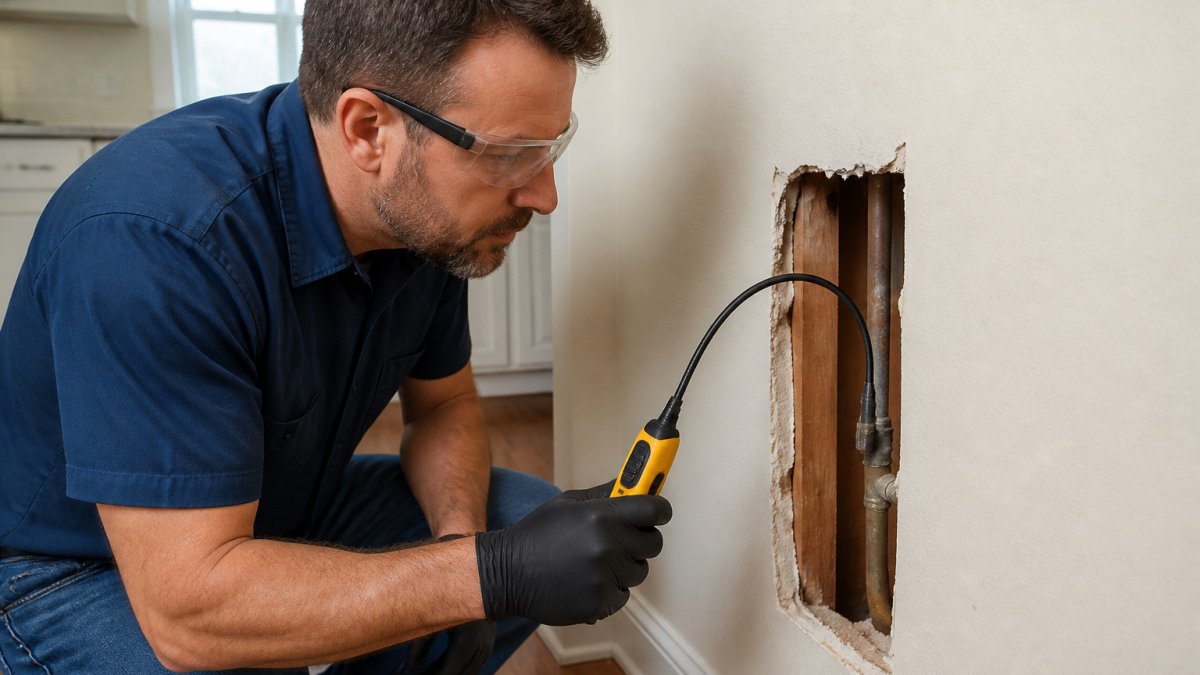
Once testing and detection point to a specific cavity, the technician may make a small, controlled opening, often at a fitting, valve, or known pipe route, rather than demolishing a wall. In some cases a borescope camera is inserted through a small hole to inspect the pipe and fittings without major damage. Repair is then made by a licensed gas fitter, and the line is pressure-tested again before service is restored.
What this means for you
A thorough inspection should include detection at multiple points, a pressure test of the isolated line, and a clear explanation of how the source was narrowed before any wall is opened. If a contractor proposes to cut into drywall first and "look around," ask why pressure testing and detection were not used to narrow the location. The goal is to confirm the leak and its location with instruments, then make the smallest possible opening to repair it.
Book a Licensed Gas Leak Inspection Before You Open a Wall
If you suspect a hidden gas leak, do not open walls to look for it. A professional inspection is the safe path. England's Plumbing & Heating serves homeowners in Chester County, Pennsylvania.
If you have questions about gas piping safety standards first, you can review our gas pipe installation safety guide for background. If you hear a hissing sound near your furnace or other appliance, read our guide on whether a hissing gas line is dangerous and act on its steps right away.
Gas leaks are not a problem to test on your own. Leave the building, call your gas utility, and then get a licensed professional to confirm the leak and make the repair.
Frequently Asked Questions
How can you tell if there is a gas leak inside a wall?
Inside a wall you usually cannot see the leak, so look for indirect signs. A persistent rotten-egg or sulfur-like odor, especially near an appliance or where a gas line enters a room, is the most common clue. Hissing or whistling near a wall, a gas meter that keeps moving when all appliances are off, or dead or unusually healthy plants growing in a line along the wall can also point to a problem. Any of these signs warrants leaving the area and calling your gas utility or a licensed plumber rather than investigating the wall yourself.
Can a gas leak make you feel sick?
Yes. Natural gas itself is not toxic in small amounts, but a leak can displace oxygen in an enclosed space and create a fire or explosion risk. Symptoms people sometimes notice include headache, dizziness, nausea, or fatigue, especially when several people in the same home feel unwell at once. If you feel these symptoms and suspect a leak, get everyone outside to fresh air immediately and contact your gas utility from a safe location. Do not wait to see if the symptoms pass.
What should you do if you suspect a gas leak in your home?
Act quickly and in this order. Avoid creating sparks: do not switch lights on or off, use phones, or operate electrical devices inside the home. Open windows and doors if it is safe to do so on your way out, then leave the building. Once you are outside and at a safe distance, call your gas utility's emergency line or 911. Do not try to locate the leak by opening walls or using flames. Wait for the utility or a licensed plumber to confirm the problem and make repairs before returning inside.
Who should you call to check for a gas leak?
Call your local gas utility first, since many utilities respond to suspected leaks at no charge and can shut off service at the meter if needed.