 how-to
7 Boiler Safety Tips for Homeowners to Prevent Danger
Last Updated: October 29, 2026
Quick Summary
Boiler safety means inspecting, monitoring, and maintaining your heating system so it burns fuel cleanly, holds the right pressure and temperature, and vents exhaust outside. Do monthly checks like the pressure gauge, water level, leaks, and flue, and never ignore a gas odor, yellow flame, or rising pressure.
- Run monthly checks during heating season: pressure gauge, water level, leaks, corrosion, noise, clear access, and flue condition.
- A yellow or orange burner flame means incomplete combustion, which produces carbon monoxide.
- Install a carbon monoxide alarm on every level of the home and outside each sleeping area.
- If you smell gas, do not touch anything electrical, get everyone out, and call from outside.
- Never cap, plug, or hold down a pressure relief valve to stop a drip.
Table of Contents
- Why Boiler Safety Matters in Every Home
- Your Home Boiler Maintenance Checklist
- Boiler Warning Signs You Should Never Ignore
- Boiler Carbon Monoxide Safety: Alarms and Emergency Response
- What to Do if You Smell Gas Near a Boiler
- Safe Operating Boundaries for Homeowners
- Seasonal Boiler Safety Planning for the Year Ahead
- Book a Professional Boiler Safety Inspection
- Frequently Asked Questions
Why Boiler Safety Matters in Every Home
A boiler is a closed pressure vessel full of hot water, and when it fails, it fails in your basement while you sleep.
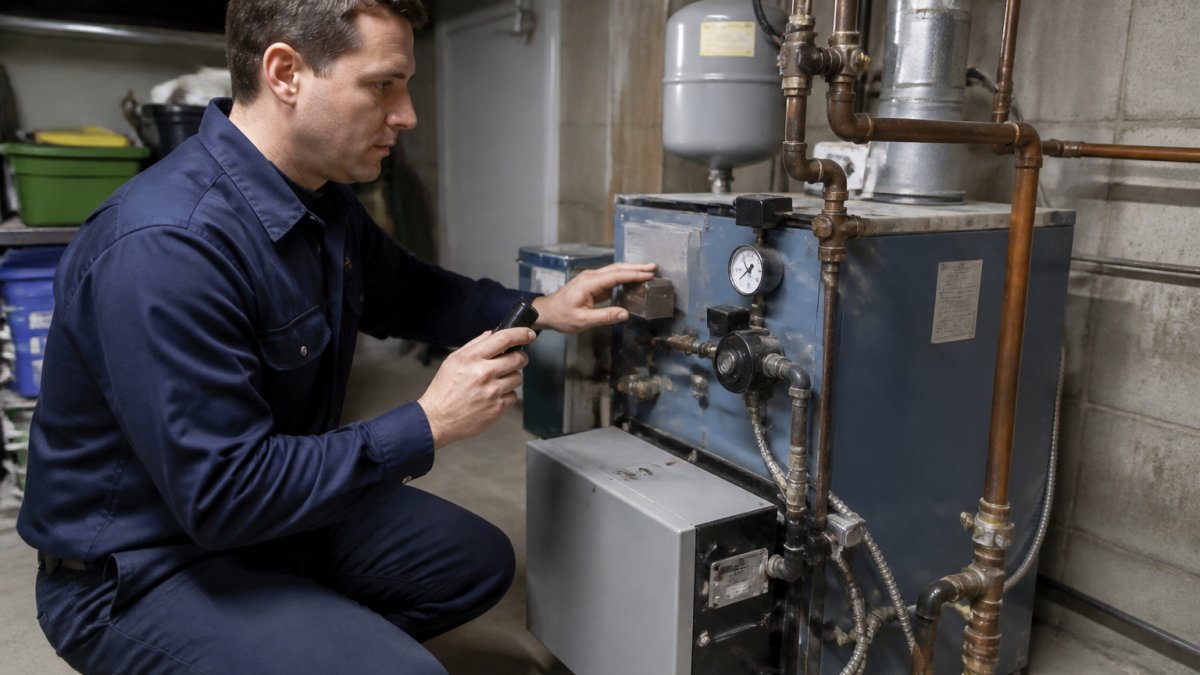
A boiler has a fuel supply, burner, combustion chamber, heat exchanger, and flue.
Below, we cover the checks you can safely do yourself, the signs that mean stop and call a professional, and the hard boundaries of what stays off-limits.
Your Home Boiler Maintenance Checklist
A home boiler maintenance checklist is a short list of visual and functional checks you can do yourself, split into monthly and pre-season tasks. It does not replace professional servicing; it catches small problems between visits, where most expensive failures start.
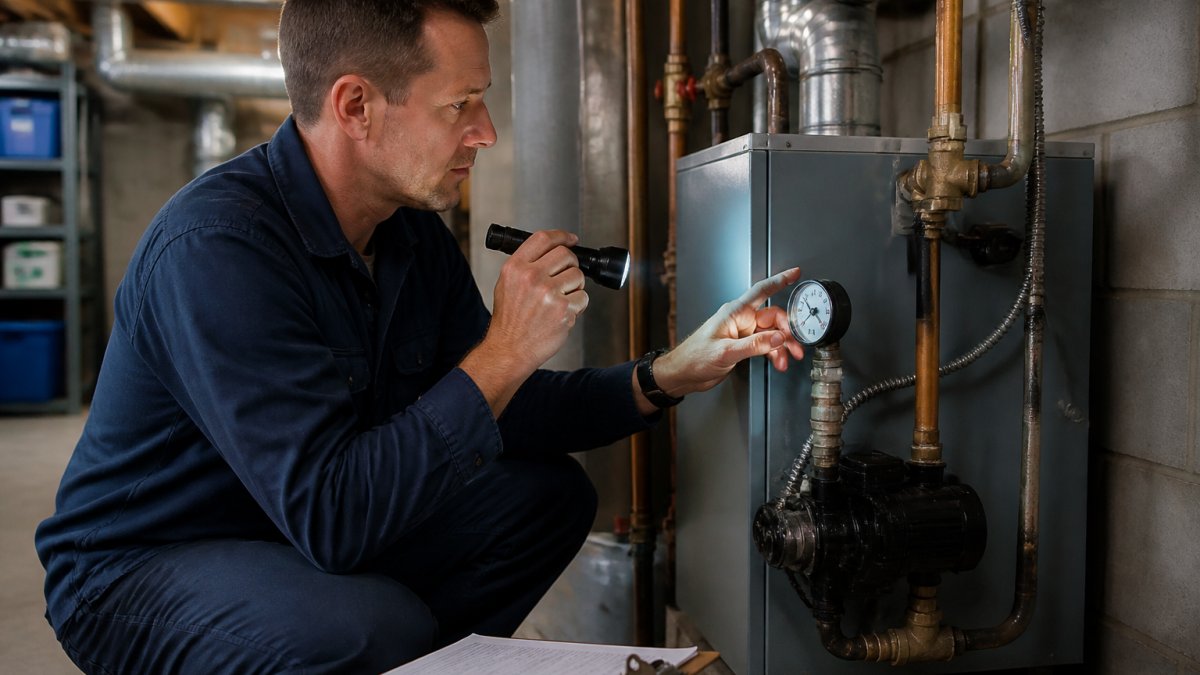
What to Check Monthly
Run these checks once a month during heating season; each takes a few minutes.
- Water pressure. The gauge needle should sit in the range marked on the unit or in the manufacturer instructions. Rising pressure with no temperature change points to a filling problem.
- Water level. If your boiler has a sight glass, confirm water sits at the marked line. Low water level is a serious fault.
- Leaks. Look for drips, rust streaks, or white mineral crust around pipe joints, the pressure relief valve, and the boiler base.
- Corrosion and dust. Wipe down the boiler jacket and check for rust spots. Dust on the burner area reduces efficiency and can cause overheating.
- Abnormal noise. Banging, kettling, or whistling means the system needs attention. Normal operation is quiet.
- Clear access. Keep the boiler room clear of boxes, paint cans, and clutter. The unit needs airflow and a clear path for a technician.
- Flue and vent. Confirm the flue pipe is connected, undamaged, and not blocked by nests or debris. Keep the outdoor vent area clear too.
What to Check Before Each Heating Season
Before the cold arrives, do a fuller pass:
- Thermostat setting. Test heat and cool modes, replace batteries, and confirm the schedule matches how your family lives.
- Electrical connections. Look for damaged wiring, scorch marks, or loose conduit. Do not open panels.
- Fasteners and gaskets. Check that access panels sit flush and gaskets and fasteners look intact, not cracked or loose.
Boiler Warning Signs You Should Never Ignore
The warning signs that matter most involve smell, sound, or color: a gas odor, a yellow burner flame, banging or kettling, water around the base, or a pressure gauge that keeps climbing. Any one means stop using the boiler and get it looked at.
Here is how to read the common ones:
- A yellow or orange flame. The burner should burn blue. Yellow means incomplete combustion, which produces carbon monoxide.
- Soot or black marks near the burner. A sign of poor combustion and a real hazard.
- Banging, hammering, or kettling. Often scale or trapped air, sometimes a failing circulator. It will not fix itself.
If you spot any of these, shut the system down at the thermostat and do not restart it. For urgent situations, our guide on emergency boiler repair services explains what to do next. If your system has already quit, read what to do before you call for help so you handle the first hour safely.
Boiler Carbon Monoxide Safety: Alarms and Emergency Response
Carbon monoxide is the hazard homeowners underestimate most, because it has no smell, no color, and no taste. Boiler carbon monoxide safety comes down to three things: a working CO alarm, a clear flue, and knowing the symptoms.
Install a carbon monoxide alarm on every level of the home and outside each sleeping area (CO Alarms). The U.S. Consumer Product Safety Commission guidance on CO alarms recommends alarms in the hallway near each separate sleeping area and on every level of the home.
Know the symptoms: headache, dizziness, nausea, shortness of breath, confusion. If the alarm sounds or anyone in the home feels these symptoms:
- Get everyone outside immediately.
- Call 911 from outside the building.
- Do not re-enter until emergency responders clear it.
- Do not restart the boiler until a qualified technician has inspected it.
A CO alarm is a backstop, not a substitute for maintenance. Alarms fail, and they only trigger at levels that are already dangerous.
What to Do if You Smell Gas Near a Boiler
A gas odor near a boiler turns a maintenance task into an emergency. Natural gas and propane can collect in a basement or utility closet and are explosive across a surprisingly narrow band of concentrations. The smell is added by the utility, the fuel is naturally odorless, so if you can smell it, treat it as real until a professional proves otherwise.
The first sixty seconds
- Do not touch anything electrical. No light switches, thermostat, garage door opener, or phone charger. A spark is enough to ignite accumulated gas.
- Do not use your phone inside. Phones and flashlights can spark. Leave them in your pocket until you are outside.
- Do not try to find the leak. Do not spray soapy water, open the boiler panel, or shut a valve you are not trained to operate. Finding the leak is the utility's job.
- Get everyone out, including pets, through the nearest door. Leave the door open behind you if you can do it without delay, to help gas dissipate.
- Call from outside. Use your gas utility's emergency line first; call 911 if you cannot reach the utility, hear a hissing sound, or anyone feels ill.
- Wait for the all-clear. Do not re-enter or restart the boiler until the utility or a licensed technician says it is safe.
Gas utility vs. 911: who to call
Your gas utility owns the line up to the meter and is the fastest route for a suspected leak, because they can shut off service and test the line. Call 911 if you smell gas strongly, hear hissing, see a damaged line, or anyone has symptoms. Many utilities publish a 24-hour emergency number on your bill and on a sticker near the meter, find it now and save it in your phone.
Propane and oil are different
If your boiler runs on propane, the tank and regulator are part of your system, and the supplier, not the natural gas utility, handles leaks. Propane is heavier than air and pools in low spots like basements and crawlspaces, so the smell may be strongest near the floor. Our guide on how to detect hidden gas leaks in walls safely covers slow leaks that never produce a strong odor.
After the all-clear
Once the utility clears the building, do not simply restart the boiler. A licensed technician should inspect the burner, gas piping, and flue before the system goes back into service, because a repaired leak may have been a symptom of a larger combustion or venting problem. If your system has already shut down, read what to do before you call for help so you handle the first hour safely, and for urgent situations our guide on emergency boiler repair services explains how to get help fast.
Safe Operating Boundaries for Homeowners
Homeowners should handle visual checks, filter changes, thermostat settings, and recordkeeping. Everything involving gas piping, the burner, combustion adjustment, electrical panels, and the pressure relief valve belongs to a licensed professional.
Here is the line, in plain terms:
| Task | Homeowner | Professional |
|---|---|---|
| Visual checks, dusting, clear access | Yes | Yes |
| Thermostat settings and schedules | Yes | Yes |
| Filter changes | Yes | Yes |
| Reading the pressure gauge | Yes | Yes |
| Gas piping and connections | No | Yes |
| Burner and combustion adjustment | No | Yes |
| Electrical panel or wiring work | No | Yes |
| Pressure relief valve testing | No | Yes |
| Flue and vent repair | No | Yes |
The reason is simple. Gas piping requires leak testing and knowledge of the standards that govern it, which our guide on gas pipe installation safety standards explains in detail.
Watch out: never cap, plug, or hold down a pressure relief valve to stop a drip.
Seasonal Boiler Safety Planning for the Year Ahead
Seasonal planning beats emergency repairs every time, but most homeowners plan by feel rather than by calendar. The first cold snap produces a wave of breakdowns on systems that sat idle all summer, clustered around parts that were never checked, the flue, the pressure relief valve, the low-water cutoff, and the CO alarm battery. A simple schedule, plus a written record, closes most of that gap.
A practical annual schedule
- Early fall (before the first cold snap). Book a professional service. Ask the technician to check the burner, heat exchanger, flue draft, pressure relief valve, low-water cutoff (on steam and some hot-water systems), and flame safeguard. This is also the right time to replace CO alarm batteries and test every alarm.
- Every month during heating season. Run the monthly checklist above: pressure gauge, water level, leaks, corrosion, noise, clear access, and flue condition. Write down the gauge reading and the date.
- Midwinter. Recheck pressure and water level, and clear snow or ice from the outdoor vent termination. A blocked vent is a carbon monoxide hazard, not just an efficiency problem.
Safety devices and their limits
A residential boiler relies on a small set of safety devices, and each has a job you should understand without testing it yourself:
- Pressure relief valve. Opens to release excess pressure before the vessel or heat exchanger is damaged. Never cap, plug, or hold it down to stop a drip, a valve that fails closed is worse than one that weeps.
- Low-water cutoff. Shuts the burner off when water drops below a safe level. On steam systems it is a critical safeguard; on some hot-water systems it is present too. It should be checked by a technician, not bypassed.
- Flame safeguard. Proves a flame is present before fuel continues to flow. If it fails, the burner may not light or may shut down repeatedly, a job for a professional.
Documentation that pays for itself
Keep a simple log: date, gauge reading, any noise or leak observed, service dates, and the technician's findings. Records can help the next service visit go more smoothly and give a technician a baseline to compare against.
Long-term planning
Boilers have a service life, and a unit that needs repeated repairs may be signaling that it is reaching the end of that life. Ask a qualified technician for an assessment of remaining life.
Book a Professional Boiler Safety Inspection
A professional boiler safety inspection is the one task on this list you cannot do yourself. A qualified technician can test combustion and inspect components that a visual check cannot reach.
England's Plumbing & Heating has served Chester County since 1989, offering residential plumbing and heating services.
If you are ready to schedule, see our services and book online.
Frequently Asked Questions
What boiler safety checks can homeowners do themselves?
Homeowners can check the pressure gauge and water level, look for leaks, corrosion, or soot around the boiler, confirm vents and flues are clear, test the thermostat, and press the test button on carbon monoxide alarms. Listen for abnormal noise and smell for gas. Anything involving burner components, electrical wiring, or gas piping should be left to a licensed technician. Keep a simple log of what you check and when.
How often should a home boiler be serviced?
Schedule professional servicing once a year, ideally before the heating season starts. Annual service covers combustion checks, cleaning, fastener and gasket inspection, and a review of the heat exchanger. Between visits, do monthly walkthroughs of the boiler room and keep maintenance records so your technician can spot trends. If you notice warning signs like pressure buildup or unusual noise, book an inspection sooner rather than waiting for the annual date.
What are the warning signs of an unsafe boiler?
Watch for gas smells, yellow or orange burner flames instead of blue, soot or scorch marks, water pooling near the unit, pressure that keeps climbing, banging or rumbling noises, and carbon monoxide alarms sounding. Any of these means stop using the boiler and call a professional. Do not try to relight a burner or reset a lockout repeatedly. Document what you saw and when so the technician has a clear picture.
What should I do if I smell gas near my boiler?
Leave the building immediately and do not touch light switches, appliances, or your phone until you are outside. Do not try to shut off the boiler yourself if you have to pass through the gas smell to do it. Once clear, call 911 and your gas utility's emergency line, then contact a licensed heating professional. Keep everyone away until the utility confirms it is safe to return.
Most homeowners wait until the boiler quits, and by then the choice is made for them. Get ahead of it. England's Plumbing & Heating offers residential boiler and heating service, gas piping work, and water heater repair and installation, backed by a team that has served this community since 1989. Book online and get a professional boiler safety inspection on the calendar before the cold sets in.