 how-to
What Size Well Pump Do I Need for My House
Table of Contents
- Determine Your Household Water Demand
- Measure Your Well Yield and Water Level
- How to Calculate Well Pump Size Using Flow Rate and Pressure
- Well Pump Gallons Per Minute for a House: Matching Capacity to Demand
- Sizing a Well Pressure Tank for Your Pump
- Use a Well Pump Sizing Chart to Select the Right Model
- Common Mistakes to Avoid When Sizing Your Well Pump
- Seasonal Variation and Protecting a Low-Yield Well
- Frequently Asked Questions
Last Updated: October 9, 2026
Determine Your Household Water Demand
The first step in figuring out what size well pump do I need for my house is calculating your household's water use.
Count your fixtures, bathrooms, sinks, showers, toilets, outdoor spigots, then factor in how many people live there.
Peak demand matters most: the moment multiple fixtures run at once, like a shower, washing machine, and bathtub. Your pump must handle it.
Most homes need between 10 and 20 gallons per minute during peak use. Here's a practical breakdown:
- Small household (1-2 people): 10-12 GPM
- Average family (3-4 people): 12-15 GPM
- Large family (5+ people): 15-20 GPM
- Households with irrigation or livestock: 20+ GPM
Write down your peak demand number for the next steps. We help Chester County homeowners understand their water usage so they select the right equipment from the start.
Measure Your Well Yield and Water Level
Your well's yield, the water it produces continuously without running dry, determines what your pump can safely pull.
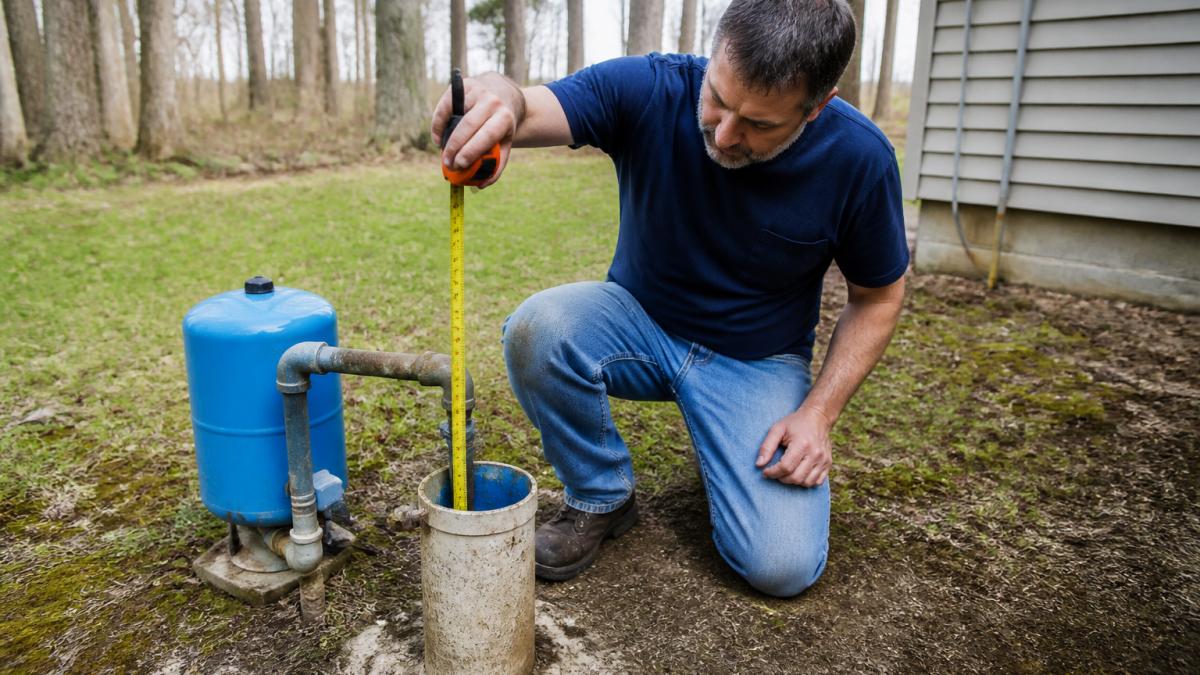
You need three measurements before sizing anything: static water level, pumping water level, and recovery rate.
Static water level. The level when the pump has been off at least an hour.
Pumping water level. Run an outdoor faucet at full flow 10-15 minutes and measure again.
Recovery rate. The test most homeowners skip, and the one that matters most.
What the numbers mean together.
- Above 10 GPM: the well supports a standard submersible sized to household demand.
- 5-10 GPM: size the pump to recovery rate and add a larger pressure tank or cistern.
- Below 5 GPM: use a storage-tank-and-booster system, not a direct-feed pump.
How to Calculate Well Pump Size Using Flow Rate and Pressure
What size well pump do I need for my house depends on both flow rate (gallons per minute) and pressure (pounds per square inch, or PSI).
Most household pressure tanks cut in at 40 PSI and out at 60 PSI, so the pump starts at 40 and stops at 60.
Calculate TDH using this formula:
TDH = Well depth + Pressure + Friction loss
For a typical house, friction loss in standard piping runs about 10-20 feet.
Match your pump to this TDH and flow rate. A pump curve graphs how much flow a pump delivers at different pressure levels.
Well Pump Gallons Per Minute for a House: Matching Capacity to Demand
Well pump gallons per minute for a house should exceed peak demand by a small margin, a 15 GPM peak demand calls for a pump rated 15-18 GPM.
Oversizing makes a pump cycle rapidly, wearing out the pressure tank and switch and wasting energy. Undersizing means it can't meet peak demand and pressure drops.
The right size pump runs longer but fewer cycles, extending equipment life and saving electricity. The main types:
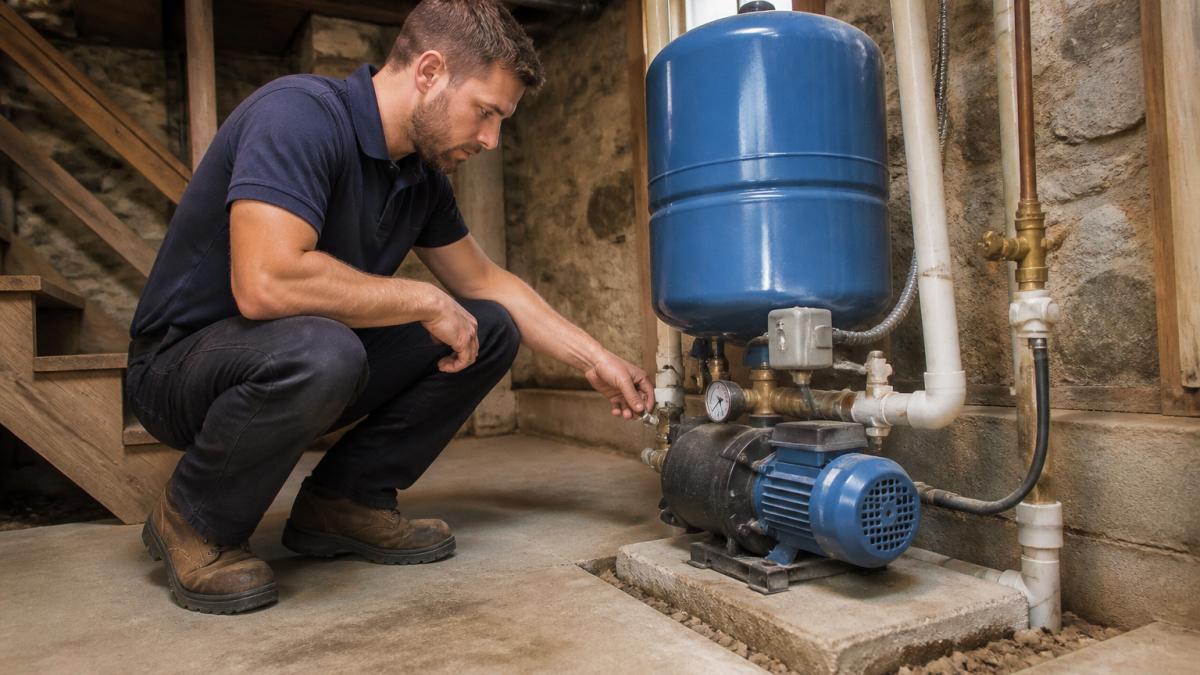
- Submersible pumps: sealed units lowered into the well casing
- Jet pumps: surface-mounted units for shallow wells under 25 feet
- Centrifugal pumps: handle higher flow rates for larger homes
Submersible pumps work best for deep wells because they push water up from below; jet pumps suit shallow wells but lose efficiency at depth. We know which type performs best at each depth and yield.
Sizing a Well Pressure Tank for Your Pump
Your pressure tank stores water between pump cycles so the pump doesn't start every time a faucet opens, extending pump life and steadying pressure.
Tank size depends on pump flow rate and cycle frequency.
Use this formula:
Tank size = (Flow rate × 60 seconds) ÷ 4 cycles
If your pump delivers 15 GPM, the calculation is (15 × 60) ÷ 4 = 225 gallons. Round up to a 250-gallon tank.
A 40-gallon tank suits a 10 GPM pump, 120 gallons fits 12-15 GPM, and 18-20 GPM pumps need 250-500 gallons.
The pressure switch controls on/off: set 40 PSI cut-in and 60 PSI cut-out for standard use.
Use a Well Pump Sizing Chart to Select the Right Model
A well pump sizing chart simplifies selection. Here's a practical guide matching household needs to pump size:
| Household Size | Peak Demand (GPM) | Well Depth | Recommended Pump Type | Typical Horsepower |
|---|---|---|---|---|
| 1-2 people | 10-12 | Shallow (under 25 ft) | Jet pump | 0.75-1 HP |
| 1-2 people | 10-12 | Deep (25-100 ft) | Submersible | 0.75-1 HP |
| 3-4 people | 12-15 | Shallow (under 25 ft) | Jet pump | 1-1.5 HP |
| 3-4 people | 12-15 | Deep (25-100 ft) | Submersible | 1-1.5 HP |
| 5+ people | 15-20 | Shallow (under 25 ft) | Jet pump | 1.5-2 HP |
| 5+ people | 15-20 | Deep (25-100 ft) | Submersible | 1.5-2 HP |
Your actual pump size may differ based on your TDH calculation and well yield.
Worked Example: Sizing a Pump for a 4-Person Home
Suppose you have a family of four, a 180-foot well, a static level of 60 feet, a pumping level of 90 feet, and a peak demand of 14 GPM. Here's how the chart and TDH calculation come together.
- Vertical lift. Pumping level (90 ft) to the highest fixture, say a second-floor shower 20 feet above grade: 90 + 20 = 110 feet of vertical lift.
- Pressure. 60 PSI cut-out converts to feet of head by multiplying by 2.31: 60 × 2.31 ≈ 139 feet.
- Friction loss. For 1-inch drop pipe at 14 GPM, a common figure is about 4 feet of loss per 100 feet of pipe. On a 180-foot run, that is roughly 7 feet. Add 5 feet for fittings and the pressure tank manifold: 12 feet.
- Total dynamic head. 110 + 139 + 12 ≈ 261 feet of TDH.
Now open the pump curve for a 1 HP, 230-volt submersible. Find where the curve crosses 261 feet of head. If it shows 14 GPM, the pump fits; if 9 GPM, step up to 1.5 HP and check again. The chart gets you into the right horsepower range; the curve confirms the exact model.
Reading a Pump Curve in One Minute
A pump curve graphs flow (GPM) horizontally against head (feet) vertically, with a separate curve per horsepower. It slopes down left to right: as head rises, flow falls. Plot your TDH, draw a horizontal line, and read the GPM at the intersection, that's what the pump delivers in your well. If it's below peak demand, step up a horsepower.
Electrical Compatibility: The Step Most Charts Skip
Horsepower is only half the story. Before buying, confirm your electrical service can run the pump.
- Voltage. Most submersible pumps in the 0.5-1.5 HP range run on 230 volts, not 115. A 230-volt circuit requires a double-pole breaker and two hot conductors run to the well. If your well currently has a 115-volt circuit, upgrading to 230 volts is part of the job.
- Phase. Residential wells almost always use single-phase power. Three-phase pumps exist but are typically reserved for agricultural or commercial installations.
- Circuit capacity. A 1 HP, 230-volt submersible draws roughly 8-9 amps running, but the locked-rotor amps at startup can be three to four times higher. A 20-amp, 230-volt circuit is common for 1 HP; 1.5 HP often needs a 25- or 30-amp circuit. Check the motor nameplate and the manufacturer's recommended breaker size.
- Control box. Some submersible motors use a separate control box mounted above ground that houses the start capacitor and relay. Others have the start components built into the motor. If you replace a pump, the control box may need to match the new motor, a mismatched box is a common cause of premature motor failure.
- Pressure switch and low-water cutoff. The pressure switch controls cut-in and cut-out. A low-water cutoff protects the motor if the well runs dry. Both are wired into the same circuit and must be rated for the pump's voltage and amperage.
Higher horsepower delivers more flow at higher pressure but costs more to run: a 1 HP pump uses roughly 750 watts, a 2 HP about 1,500. The right pump is the smallest that meets your peak demand at your calculated TDH, not the largest that fits the casing.
Common Mistakes to Avoid When Sizing Your Well Pump
The biggest mistake is ignoring well yield, buying a pump based on what you want to use, not what the well provides.
Another error is guessing well depth or assuming levels stay constant.
Oversizing wastes money and wears the pressure tank: a too-large pump cycles too fast, stressing the switch and diaphragm and raising repair costs.
Underestimating friction loss disappoints: many calculate TDH from well depth and pressure alone, forgetting pipe resistance.
Not checking electrical compatibility causes delays.
Seasonal Variation and Protecting a Low-Yield Well
Water levels fluctuate with seasons and rainfall: spring brings the highest levels, summer and fall decline as groundwater recharges slowly, and winter depends on snowmelt and rain.
If your well yields under 10 GPM, seasonal changes matter: a well producing 8 GPM in spring might drop to 5 GPM by late summer, affecting pump choice and tank size.
For low-yield wells, consider these strategies:
- Install a larger pressure tank to store more water
- Use a pump that matches your lowest seasonal yield, not peak demand
- Add a backup water source like a cistern for dry periods
- Reduce peak demand by staggering water use
- Avoid irrigation or livestock watering during dry months
A pressure tank is essential for low-yield wells: it lets the pump run longer but less often, giving the well time to recover.
Monitor water levels annually, checking static level in late summer when levels are lowest. We serve Chester County homeowners with well pump expertise and can help you select equipment that performs reliably year-round.
Sizing a well pump correctly saves money, prevents equipment failure, and ensures your household has reliable water. When you're ready to install or replace a pump, work with professionals who understand Chester County wells and can guide you through selection and installation. The U.S. Geological Survey provides guidance on private well management.
Frequently Asked Questions
How many gallons per minute should a well pump deliver for a house?
Most households need 8 to 12 GPM for normal daily use, including showers, laundry, and dishwashing. Peak demand during simultaneous use (two showers plus laundry) can reach 15 to 20 GPM. Your actual requirement depends on family size, number of bathrooms, and water-use habits. If your well yield is lower than household demand, your pump must match the sustainable yield of your well to avoid drawdown and recovery issues.
What size well pressure tank do I need?
A 20-gallon pressure tank is adequate for most single-family homes with 3 to 4 people. Larger households or those with high peak demand may benefit from a 30 to 40-gallon tank to reduce pump cycling and extend pump life. Tank size affects how often your pump turns on and off; undersized tanks cause frequent cycling, while oversized tanks provide longer run periods between cycles. Calculate based on your GPM requirement and acceptable pressure drop.
Can an oversized well pump damage a well or pressure system?
Yes. An oversized pump can exceed your well's sustainable yield, causing rapid drawdown, air entry into the suction line, and premature pump wear. It also creates excessive pressure spikes that stress pipes and fittings. The pump must be sized to match both household demand and well yield; if your well yields only 5 GPM, a 15 GPM pump will exhaust the well and cycle on and off repeatedly, shortening its lifespan and potentially damaging the pressure tank and control box.
Does well depth affect what size pump I need?
Yes. Well depth determines total dynamic head (TDH), which is the vertical lift plus friction loss in pipes and fittings. A shallow well at 25 feet requires less head than a deep well at 200 feet. Greater depth means higher horsepower is needed to deliver the same flow rate. You must calculate TDH by measuring static water level and pumping water level, then adding pressure requirements and friction loss to select a pump with adequate horsepower for your depth and flow demand.